We can’t ignore how a single fault in a portable BMS could cascade into a total battery failure. In this discussion, we’ll break down how voltage, current, temperature, and SOC data underpin protection, balancing, and reliability. We’ll assess sensing accuracy, fault tolerance, and practical integration for real-world devices, then show how these elements translate into safer, longer-lasting power packs. Stay with us as we map the tradeoffs and decision points that matter most to portable systems.
Key Takeaways
- Portable BMS provides compact, integrated monitoring, protection, and cell balancing to safeguard mobile battery packs and optimize performance.
- Core functions include voltage/current/temperature sensing, SOC estimation, health monitoring, and predictive aging alerts for proactive maintenance.
- Balancing methods (passive vs active) and tailored protections (over/under voltage, overcurrent, fault handling) ensure safe, efficient operation.
- Real-time data, fault logging, and clear indicators enable robust diagnostics, maintenance, and alignment with charging strategies and thermals.
- Practical integration covers sensor placement, communication reliability, and packaging that support safety, longevity, and regulatory compliance.
What a Portable BMS Is and Why It Matters
A portable Battery Management System (BMS) is a compact, integrated solution that monitors and protects battery packs in mobile applications. We define its role by framing the system’s scope: safeguarding cells, managing balance, and ensuring safe operation. We examine how battery chemistry shapes protections, charging profiles, and fault responses, recognizing that chemistries dictate voltage windows, impedance behavior, and degradation risks. We then map core functions to practical outcomes, connecting monitoring to decision logic that drives protection and state reporting. Our focus remains on how charging algorithms coordinate safe, efficient energy transfer, adjusting current and voltage limits to match chemistry, temperature, and pack configuration. By articulating requirements, we show why a portable BMS matters for reliability, safety, and performance in dynamic environments.
Core Functions of a Portable BMS: Voltage, Current, Temperature, and SOC
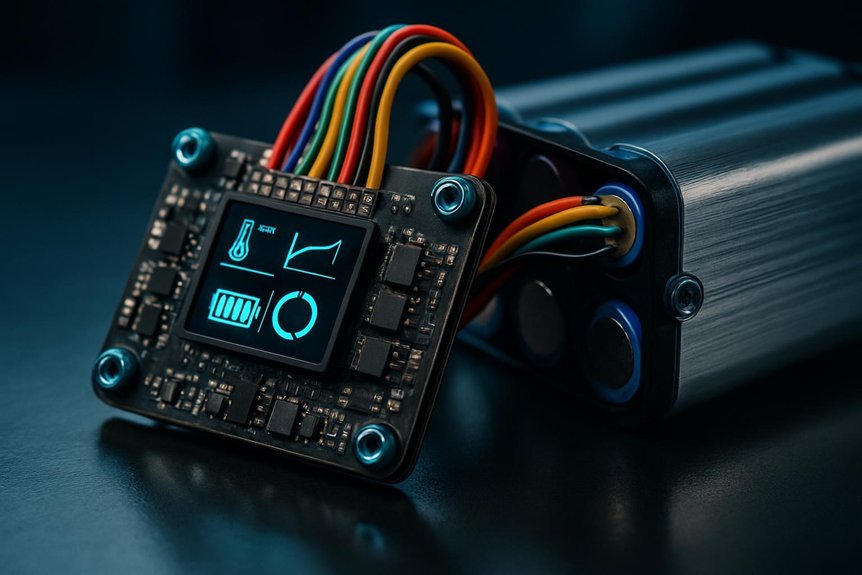
We start by outlining how Voltage Monitoring Essentials and SOC/Temperature Tracking underpin reliable portable BMS performance. We examine how precise voltage readings, coupled with tight SOC estimates and temperature awareness, enable safe charging, accurate state awareness, and proactive protection. In short, these core functions provide the measurable signals we use to manage power, monitor health, and guide decision-making.
Voltage Monitoring Essentials
Ever wonder how a portable BMS reliably tracks each cell’s state? We approach voltage monitoring with disciplined rigor, mapping cell potentials to a trustworthy state estimate. We quantify cell voltages using precision ADCs, calibrate for common-mode errors, and apply isolation where needed to prevent ground bounce from skewing results. We continuously validate voltage trends to catch drift, and we differentiate instantaneous voltage from long-term changes to avoid false alarms. We design around battery chemistry and charging topology to ensure representative measurements across all cells, including balancing interactions that affect readings. We treat voltage data as the backbone of state awareness, coordinating with current and temperature channels, while keeping the focus on reliable cell-level insights that support safe, predictable operation.
SOC and Temperature Tracking
How do we reliably track State of Charge (SOC) and temperature in a portable BMS? We approach SOC via model-based estimation and coulomb counting, cross-validated with voltage, current, and impedance data. Temperature tracking combines sensor placement, thermal models, and compensation in SOC algorithms to prevent bias from hotspots. We avoid irrelevant concept drift by aligning measurements to a common reference and filtering noise. This yields stable SOC estimates across charge/discharge cycles and varied ambient conditions, essential for safety and performance.
1) Use fused measurements from multiple sensors to improve accuracy and fault tolerance.
2) Calibrate temperature sensors against a thermal model that accounts for pack geometry and cooling.
3) Regularly validate SOC with cell impedance and voltage response to detect degradation, avoiding unrelated topic distractions.
How a BMS Monitors Health: Real-Time Sensing and Alerts

We monitor real-time health metrics to track cell balance, degradation trends, and pack integrity, ensuring we catch anomalies as they happen. When thresholds are crossed, we trigger alarms and log events that guide immediate safety actions and long-term reliability planning. We also use predictive aging alerts to anticipate capacity loss, enabling proactive maintenance and smarter replacement timing.
Real-Time Health Metrics
- Correlation of voltage, current, and temperature trends to detect aging and imbalance
- Real-time impedance tracking as a precursor to capacity loss and fault conditions
- Mode-aware alerting that differentiates stationary vs. mobile charging scenarios
Threshold Alarms Triggers
Threshold alarms are the BMS’s first line of defense against degraded health, thresholds being the quantitative guardrails that trigger alerts when sensor data deviates from normal ranges. We monitor cell voltages, temperatures, and current in real time, translating measurements into actionable flags. When a parameter crosses a preset boundary, alarms fire, prompting immediate validation and isolation if needed. This mechanism reduces mean time to detection and helps prevent cascading failures that threaten battery longevity. We distinguish between absolute thresholds and rate-of-change limits to catch instantaneous faults and drifting trends. Alarm management integrates with logging, dashboards, and fault codes, enabling rapid diagnostics. We also consider charging topology impacts, ensuring alerts reflect safe operating envelopes across diverse charging schemes without compromising performance.
Predictive Battery Aging Alerts
How can a BMS foresee aging before it becomes critical, and what role do real-time senses play in that foresight? We answer by showing how sensors translate chemistry changes into actionable alerts. Real-time data reveals degradation trends, enabling early intervention before capacity loss accelerates. We focus on predictive signals, not just thresholds, to distinguish normal aging from rapid faulting. We also address improper charging and its impact on aging, emphasizing how mismanaged currents distort health estimates. Additionally, we separate essential indicators from nonessential metrics to keep alerts targeted and reliable. By combining data fusion, trend analysis, and calibrated models, the system delivers proactive notices rather than reactive alarms.
- Real-time trend fusion
- Early-stage degradation indicators
- Model-based health forecasts
Cell Balancing Methods: Passive vs Active
In battery management, cell balancing is essential to maximize pack capacity and longevity, and we distinguish two main approaches: passive and active balancing. We compare them by mechanism, loss profiles, and efficiency implications. Passive balancing dissipates extra energy as heat through bleed resistors, which simplifies hardware and control but lowers efficiency during high imbalance events. Active balancing transfers energy between cells or groups, preserving energy and improving efficiency optimization, at the cost of added circuitry and control complexity. We evaluate suitability by pack topology, load profiles, and thermal margins, noting that active methods excel in tightly coupled chemistries with wide cell variance. Ultimately, the choice hinges on balancing performance, size, and thermal constraints, aligning with system goals and operational duty cycles.
Essential Safety Protections in Portable BMS
We examine essential safety protections in portable BMS by focusing on fault detection and the safeguards against overcurrent and short circuits. We’ll outline how rapid fault diagnosis enables reliable shutdowns, preventing thermal runaway and component damage. Our discussion sets a precise framework for implementing robust detection, response thresholds, and fail-safe architectures.
Battery Fault Detection
- Diagnostics cadence: continuous sensing, periodic verification, and cross-checks to confirm anomalies.
- Fault taxonomy: open-circuit, impedance drift, temperature runaway, and sensor disagreement, with prioritized responses.
- Mitigation strategy: isolation, soft-fault warning, and forced shutdown when safety margins are breached.
This framework supports unrelated topic assessment and random exploration of anomaly contexts while maintaining rigor.
Overcurrent and Short-Circuit Protection
Overcurrent and short-circuit protection is essential for portable BMS safety, reliability, and user trust. We analyze how excessive current or a fault path stresses cells, wiring, and connectors, potentially causing heat, degradation, or fire. Our approach combines detection, fast isolation, and fault-tolerant architecture to minimize energy delivery during anomalies. We implement overcurrent protection by current sensing, thresholding, and time-domain filters that distinguish transient spikes from persistent faults, ensuring we don’t interrupt normal operation unnecessarily. Short circuit protection relies on rapid disconnection via solid-state switches or relays, coordinated with cell balancing and state estimation. Clear fault indicators, logging, and user guidance complete the loop, improving maintenance and safety. Together, these mechanisms reduce risk while preserving performance and battery life.
How to Choose the Right BMS for Your Pack: Criteria and Trade-Offs
Choosing the right BMS hinges on understanding your pack’s goals and constraints: what chemistry, cell count, and pack form factor you’re using, how you plan to use the device, and what failsafes are non-negotiable. We evaluate criteria and trade-offs with a focus on reliability, safety, and efficiency, avoiding over-specification. Key decisions center on battery chemistry and packaging considerations, balancing protection features against cost and weight.
1) Determine essential protections (overvoltage, undervoltage, overcurrent) versus acceptable risk.
2) Align monitoring granularity and communication needs with system complexity and cost.
3) Assess charging strategy compatibility, thermal management, and physical packaging constraints.
We present a disciplined framework to select a BMS that matches performance targets, life expectancy, and form factor, ensuring coherent integration with your pack.
Practical Integration: Wiring, Sensors, and Communication Protocols
To implement the protection and coordination decisions from our prior criteria, practical wiring, sensing, and communication must be defined with clarity. We approach wiring with a minimal, robust topology: fused starts, short runs, and labeled traces to prevent cross-talk. Sensor placement focuses on accurate current, voltage, and temperature readings, with redundancy only where it adds meaningful reliability. Communication protocols must balance speed, noise immunity, and power budget, favoring error-detecting codes and deterministic timing for critical paths. Packaging decisions hinge on packaging considerations and thermal paths that preserve sensor integrity. Enclosure design should enable access for diagnostics without compromising safety. Documentation and standardization ensure repeatability and scalable integration across packs, including modular interfaces and future expandability.
Real-World Benefits: Longevity, Safety, and Performance
How do robust battery management systems translate into real-world advantages for portable power? We assess longevity, safety, and performance through a structured lens, focusing on reliability and data-driven decisions. By aligning charge cycles with battery chemistry profiles, we minimize degradation and extend usable life, while reducing thermal stress and failure risk. We also map outcomes to market trends, ensuring deployments stay within safety standards and regulatory expectations. This analytical view helps readers anticipate maintenance needs, optimize runtimes, and compare competing chemistries with confidence. In practice, BMS-informed control translates to fewer outages, safer handling, and more consistent power delivery across varied loads.
Robust BMS extends life, boosts safety, and delivers steady power under real-world conditions.
1) Prolonged cycle life through chemistry-aware management
2) Enhanced safety via deterministic fault detection and fault-tolerant design
3) Improved performance with adaptive balancing and thermal control
battery chemistry, market trends,
Troubleshooting Common Field Issues With BMS
Field issues with BMSs can erode the real-world gains we discussed earlier if not identified and addressed promptly. When troubleshooting, we map symptoms to system layers: sensing, communication, and control logic. We begin with data validation, verifying sensor calibration and timestamp integrity, then cross-check cell voltages and temperatures against expected profiles. Look for intermittent faults in the CAN or I2C network, and confirm firmware consistency across modules to prevent misalignment of safeguards. Document each deviation, establish a baseline, and reproduce issues under controlled loads to distinguish transient from persistent faults. To reduce recurrence, we pursue redundant processes where feasible and implement disciplined change control. Our objective is cost optimization through targeted fixes that restore reliability without unnecessary rework. Clear diagnostics enable rapid, informed decisions.
Maintenance, Diagnostics, and Upgrades: Practical Guidelines
What concise maintenance, diagnostics, and upgrades should look like in practice is grounded in systematic routines, rigorous data validation, and disciplined update controls. We present a disciplined approach that reduces drift, flags anomalies early, and preserves system integrity. We address disassembly implications, ensuring any teardown is reversible and documented to avoid compromising safety or warranty considerations. Our protocol emphasizes traceable change logs, conservative firmware updates, and validated test procedures that confirm performance targets post-maintenance.
- Establish a verified maintenance cadence that includes pre- and post-test benchmarks.
- Use controlled diagnostics with reproducible results, logging all findings and decisions.
- Plan upgrades with impact assessments on warranty considerations and disassembly implications, prioritizing minimal invasiveness.
This framework keeps diagnostics precise, upgrades predictable, and maintenance outcomes auditable.
Frequently Asked Questions
How Does a Portable BMS Handle Low-Temperature Operation?
We handle low temperature by activating battery heating, delaying charging, and monitoring cell impedance and temperature. We coordinate heating with thermal management, ensuring safe, efficient startup and protection, while maintaining accuracy and reliability for you.
Can BMSES Be Retrofit to Existing Packs Safely?
We can retrofit BMSes to existing packs safely, provided we prioritize proper pack integration and rigorous safety checks. We evaluate cell balance, insulation, fault handling, and thermal management before integration, ensuring compatibility and clear failure modes for reliable operation.
What Are Wireless Vs Wired BMS Reliability Trade-Offs?
Wireless reliability tends to vary with interference and distance, while wired reliability is steadier but less flexible; we analyze, conclude, and tell you we prefer hybrids for consistency, latency, and fault isolation in real-world BMS deployments.
How Do BMS Dashboards Visualize Aging Vs Capacity Fade?
We show aging dashboards that separate capacity fade visualization from current health metrics, clarifying how degradation trends, cycle counts, and calendar aging influence remaining life, with precise thresholds and trend lines guiding proactive maintenance.
What Are Common IP and Ingress Protection Concerns for Portable BMS?
“An ounce of prevention is worth a pound of cure.” We assess common IP and ingress concerns for portable BMS: IP testing, ingress challenges, housing seals, and cable management, with rigorous, analytical attention to seals, enclosure, and connectors.
Conclusion
We’ve learned that portable BMSes aren’t magic, just meticulous librarians for your battery’s chaos. Picture a tiny control room in a phone-sized box: volts, amps, temps, SOC voting on life choices while we pretend we’re in charge. When the alarms blare, the system politely nudges us back to safety, like a very responsible but sarcasm-coated parent. In short, disciplined sensing, balancing, and protections save days, extend life, and keep our gadgets from dramatic exits.