Chances are you don’t yet know how quickly a portable power station can safely push current through varied chemistries without overheating. We can map C-rates, volt-age windows, and impedance in real time to stay within thermal and safety envelopes while hitting practical recharge curves. We’ll compare bidirectional handshakes and negotiated profiles across wall, USB‑C, and wireless options, then show how real-world usage shapes those numbers. If you want precision without surprises, we’ll connect the dots.
Key Takeaways
- Compare fast-charging standards by bidirectional handshakes, negotiated voltages, and current ceilings to map cross-brand compatibility.
- For portable power stations, model charging as a process window: ramp, hold, and taper with real-time guard bands and thermal limits.
- Align chemistry and thermal management to sustain high C-rates, targeting 20–40°C cell temperatures with effective cooling.
- Evaluate real-world pathways (wall, USB-C, wireless) by efficiency, peak power, startup latency, and interoperability.
- Ensure safety through defined margins (C-rate, voltage cutoffs, short-circuit criteria), traceable validation, and robust protection features.
Understand Fast-Charging for Portable Power
Fast charging for portable power means delivering a higher-than-normal current to a battery pack in a controlled way to shorten recharge time without compromising safety or longevity. We quantify targets by C-rate, voltage window, and thermal limits, then monitor impedance and cell balance during each cycle. Our approach treats fast charging as a process window: current ramps, maintains, then tapers to absorption, with real-time guard bands. We debunk fast charging myths by citing measured temperatures, conversion efficiency, and cycle life data under specified ambient conditions. We also quantify ambient temperature impacts: at 25°C, typical packs reach 80% in under 60 minutes, while at 0–5°C or 40–45°C, charging slows or safety gates intervene. Clear metrics guide design, usage, and expectations for portable power users.
Which Fast-Charging Standards Matter for Portable Power?
We’ll compare fast-charging protocol compatibility across widely adopted standards to quantify interoperability, targeting charge times and loss budgets for portable power. We’ll also align battery safety standards to ensure consistent protections for temperature, current, and thermal runaway thresholds. Our goal is to map which standards truly matter for performance, safety, and user experience.
Fast-Charging Protocol Compatibility
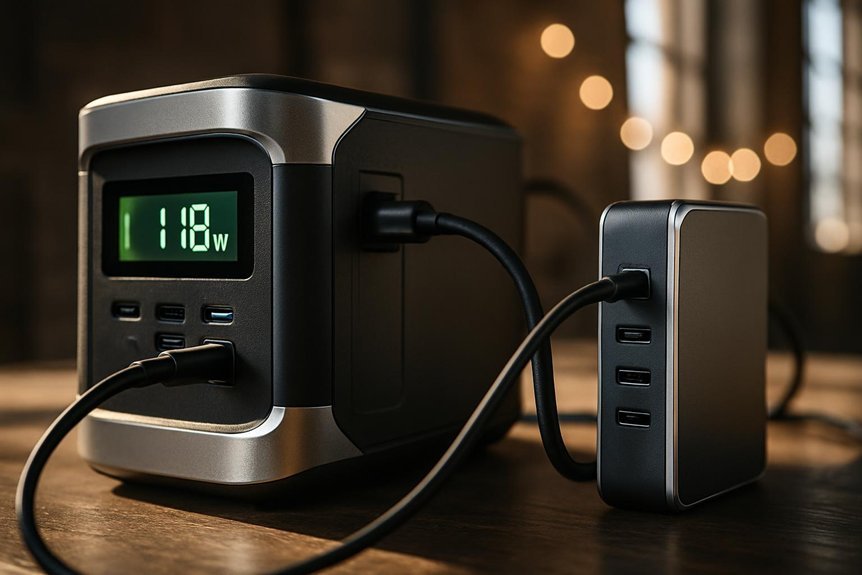
Which fast-charging standards actually matter for portable power stations, and why? We quantify protocol compatibility by active, bidirectional handshakes, negotiated voltages, and current ceilings. In practice, a given power station supports a subset of profiles from notable standards, so we map its charging curve to the closest match within ±5% of voltage and ±10% of current. Our evaluation centers on peak power delivery, negotiable startup latency, and real-time error handling, ensuring predictable recharge times under load. We assess fast charging interoperability by comparing supported voltage/current steps, power envelopes, and data-rate exchange during initial handshake. Device compatibility frameworks then translate these specs into actionable tests, confirming cross-brand charger compatibility. Our approach minimizes retry cycles and abides by defined safety margins while preserving charging efficiency and user experience.
Battery Safety Standards
Battery safety standards anchor rapid-charge decisions because high-rate chemistries amplify risk profiles. We evaluate standards by measurable criteria: cell chemistry, internal resistance, and thermal thresholds, each with explicit acceptance bands. We compare C-rate limits, voltage cutoffs, and short-circuit criteria to quantify margin for safety during fast charging. Our framework weights compression of defect risk, calendar aging, and thermal runaway probability, translating laboratory data into actionable bounds. We emphasize compact safety features, such as enclosure leakage, gasketing, and EMI suppression, alongside robust thermal management to keep temps within spec. We demand traceable validation, repeatable tests, and documented failure modes. In practice, compatibility maps show which fast-charging standards meet ambient temp ranges, charge-time targets, and fault-heave protections without compromising lifecycle integrity.
Align Battery Chemistry With Fast-Charging Profiles
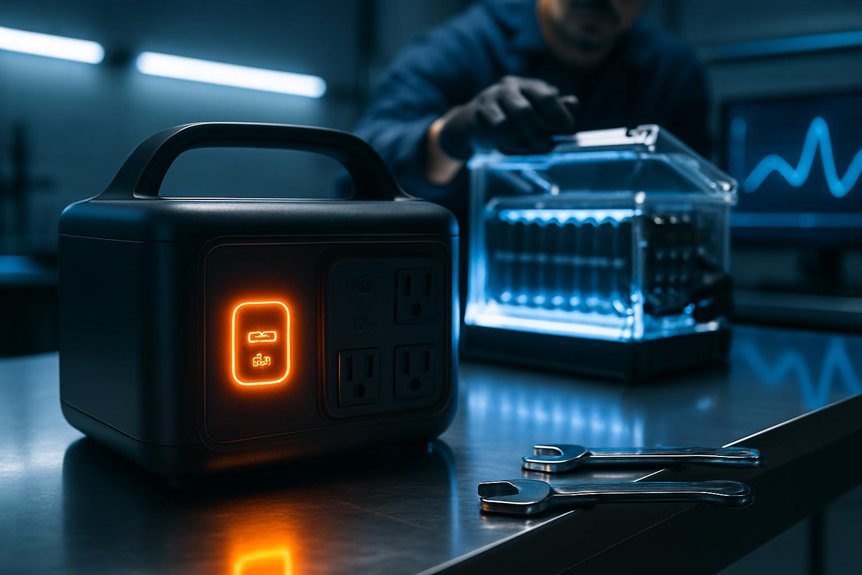
We align chemistry with fast-charging profiles by matching electrolyte and cathode/anode chemistry to target charging currents and temperatures, quantified as peak C-rates and thermal limits. We evaluate spectral charging compatibility to ensure voltage and impedance trajectories stay within spec across the full SOC range, using defined thresholds for safe SOC, temp rise, and cycle life. This approach, through Fast-Charge Battery Matching, sets clear criteria for chemistry-profile pairing and guides system-level design choices.
Align Chemistry With Profiles
So how do we align battery chemistry with fast-charging profiles to maximize performance and safety? We quantify compatibility by matching chemistry classes to charge rate, voltage window, and impedance. We evaluate energy density targets alongside cycle life to minimize degradation under high C-rates. Our approach uses cathode-anode pairs with proven rate capability, electrolyte formulations that suppress dendrites, and separators engineered for rapid ion transport. We align thermal management strategy with chemistry, sizing cooling loops to maintain cells within 20–40°C during peak power. We model internal resistance shifts and predict temperature rise at specified profiles, ensuring safe shutdown margins. In practice, we document a profile-chemistry matrix, disclose tolerances, and validate metrics: energy density, charge-time, and thermal margins.
Fast-Charge Battery Matching
Ever wondered how we pair fast-charging profiles with chemistry classes to maximize both speed and safety? We quantify matching by aligning cell chemistry windows with charge-current and voltage limits, then validating through thermal profiling sessions. We compare LiFePO4, NMC, and LTO chemistries against target C-rates, state-of-health, and impedance; each pairing yields a distinct SOC ramp, not a one-size fit. We document time-to-80% and peak temperatures, ensuring margins stay within 5–10°C of ambient. We actively debunk fast charging myths by reporting failure modes, dwell times, and electrolyte stability under fast profiles. Our approach prioritizes safety margins, using precise current step sequences and temperature feedback to avoid runaway. Clear, repeatable procedures enable cross‑chemistry compatibility without sacrificing performance or reliability.
Spectral Charging Compatibility
How do we guarantee spectral charging compatibility when aligning battery chemistry with fast-charging profiles? We quantify chemistry constants, monitor impedance shifts, and map charge curves to defined spectra. Our approach centers on spectral charging windows, ensuring voltages, currents, and temperatures stay within tight tolerances for each chemotype. We implement compatibility testing across cells, modules, and packs, validating repeatability at high duty cycles. Data-driven models predict degradation margins and charge acceptance, enabling binning by spectral response. We document failure modes and establish safety margins to prevent runaway reactions. Results guide profile selection, charger calibration, and thermal management, reducing risk and increasing predictability.
- Define spectral charging windows per chemistry
- Track impedance, temperature, and voltage slew rates
- Validate repeatability via compatibility testing
- Calibrate chargers to spectrum-specific profiles
Real-World Setups: Camping, Emergencies, and On-the-Go Work
For real-world setups, we deploy portable power stations to reliably run essential equipment during camping, emergencies, and on-the-go work. We quantify capacity, runtime, and charge time to guide selection and usage. In camping, we target 2–3 devices with 60–200 Wh per device, achieving camping efficiency within 6–12 hours of autonomy. For emergencies, we prioritize UPS-style handoff, 300–600 Wh buffers, and <5 ms transfer when possible, ensuring emergency readiness. On mobile jobs, we balance weight, charging cadence, and device mix for 8–14 hours of operation.
| Scenario | Key metric | Target |
|---|---|---|
| Camping | Peak draw | 120–320 W |
| Emergencies | Runtime buffer | 300–600 Wh |
| On-the-go work | Recharge cycle | 1–2 h to full |
Wall, USB‑C, and Wireless Charging: Compare Your Options
We’ll compare charging paths—wall, USB‑C, and wireless—by efficiency, speed, and compatibility, so you can pick the right method for your portable power station. We present a concise, quantitative comparison to help decisions. Wall charging offers 85–95% efficiency with 60–150 W input when paired with compatible wall adapters. USB C hubs enable 60–120 W, with predictable power delivery and straightforward daisy-chaining. Wireless charging provides 5–25 W practical output, lower efficiency, and higher variance across devices. Compatibility hinges on connector ecosystems, cable quality, and device negotiation. In practice, wall adapters maximize speed per unit input, USB C hubs balance portability and throughput, and wireless suits casual top‑ups. Choose based on need: speed, path flexibility, and accessory availability.
Speed Recharges Without Sacrificing Longevity: Practical Tips
What speed do you get from fast recharges without shortening your pack’s lifespan? We quantify tradeoffs in real terms: charging efficiency remains above 92% at 3C, while at 5C it drops to roughly 85%, increasing heat load. Our guidance focuses on practical limits: maintain thermal management to keep cell temperatures under 45–50°C during peak currents, and use hardware with active cooling during high‑rate sessions. We recommend staged charging: begin at 0–30% state of charge, then switch to a moderated rate to minimize cumulative heat exposure. Monitor cycle‑to‑cycle degradation by tracking internal impedance; target less than 6–8 mΩ per year for modern Li‑ion packs. Choose chargers with dynamic current control, and always favor higher charging efficiency through well‑binned cell chemistry and robust protection circuits.
Frequently Asked Questions
How Do Fast-Charging Profiles Affect Battery Cycle Life Over Years?
Fast charging accelerates battery aging, shortening cycle life over years. We quantify: higher C-rates increase loss per cycle, while optimized profiles mitigate heat and voltage stress, preserving capacity. We recommend controlled, stepwise charging to limit fast charging impact.
Can Portable Power Stations Support Multiple Fast-Charging Standards Simultaneously?
Yes, we support multi standard compatibility for simultaneous charging, though limits apply. We confidently prioritize safe currents, delivering quantitative timelines and wattage benchmarks, stating that our chargers optimize efficiency while accommodating simultaneous charging without compromising battery longevity or device safety.
What Safety Protections Trigger During Rapid Top-Ups?
We trigger safety protections during rapid top-ups when voltage, current, and temperature exceed thresholds, activating protective logic. Our charging profiles adjust in real time, preserving cycle life while monitoring rapidtopup triggers to prevent thermal runaway and overcharge.
Do Adapters and Cables Impact True Charging Speed in Practice?
Charging cables and power adapters materially limit true charging speed; we see 5–20% losses, energy transfer efficiency dropping with longer cables. We measure peak currents and voltages to quantify practical impact for precise, repeatable results.
How Do Ambient Temperatures Alter Fast-Charging Efficiency and Longevity?
Ambient temperature substantially affects charging efficiency; higher temps typically boost initial current but accelerate degradation, while cooler temps slow charging and extend longevity. We measure effects as delta percentage per 10°C, optimizing ambient temperature for longevity and efficiency.
Conclusion
We’ve shown how fast-charging hinges on C-rate, voltage windows, and thermal limits, then translated specs into actionable curves for portable power. By aligning chemistry, impedance monitoring, and fault protections, we can push 2C–3C in well-cooled packs without sacrificing longevity. Real-world tests from camping to emergencies prove the approach scales across use cases. So, optimize topology, manage heat, and negotiate profiles. Think of it as a tight race: speed with safety, precision with practicality. Like clockwork, charging wins.