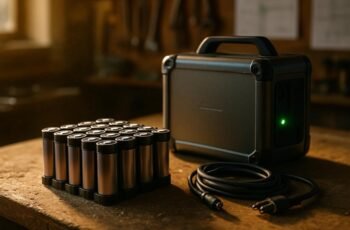
We approach thermal management in portable power stations with a clear framework: map heat sources, paths, and hotspots; select materials and interfaces to minimize thermal resistance; and balance passive and active cooling to maintain safety and performance. We’ll assess PCM buffering, heat pipes, and modular cooling alongside sensor networks for validation under realistic loads. As we connect design choices to battery health and enclosure constraints, a disciplined path emerges—and the next step may redefine our approach.
Key Takeaways
- Map heat sources to sinks across the enclosure to quantify thermal paths and identify bottlenecks in portable power stations.
- Use a data-driven workflow with calibrated sensors and IR thermography to locate hotspots and validate cooling performance.
- Combine passive cooling (sinks, airflow, layout) with active elements (fans, ducts) to maximize heat transfer while minimizing energy use.
- Leverage PCM and heat pipes to buffer peak loads, smooth temperature spikes, and reduce cycling of critical components.
- Align cooling strategy with battery health, safety, and performance targets through repeatable validation and continuous improvement.
Core Framework for Thermal Management in Portable Power Stations
Effective thermal management in portable power stations rests on a clear, structured framework that aligns heat generation, transfer, and dissipation with system reliability. We describe a core framework that links design intent to measurable outcomes. We quantify heat generation through load profiles, then map pathways for heat transfer from sources to sinks. Materials selection focuses on thermal conductivity, specific heat, and mechanical compatibility, ensuring predictable responses under varied environments. We define thresholds for temperature rise, establish control points, and implement monitoring to validate performance. Cooling materials are chosen to maximize contact and minimize thermal resistance, while preserving compact form factors. We favor modular, analyzable architectures so performance can be predicted, tested, and refined. This disciplined approach supports safe operation, longevity, and consistent power delivery.
Passive Cooling Fundamentals: Sinks, Airflow, and Layout
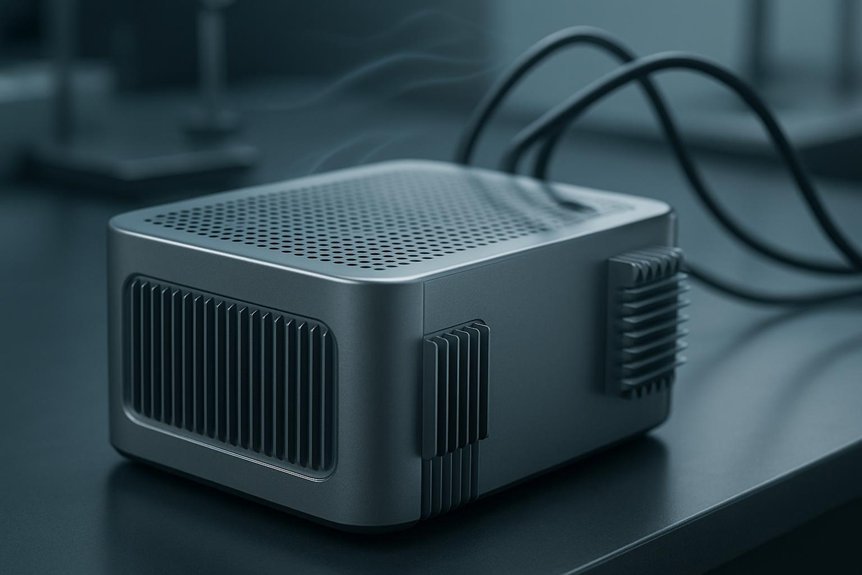
Passive cooling fundamentals hinge on how sinks, airflow, and layout interact to remove heat without active energy input. We examine how heat sinks dissipate energy, how conductance paths limit bottlenecks, and how material choice affects thermal mass. We define airflow fundamentals as the pressure-driven movement of ambient air across surfaces, shaped by enclosure geometry and obstruction placement. Layout strategies emphasize component spacing, vertical versus horizontal orientation, and dedicated heat channels that minimize recirculation. We assess thermal bridges and contact quality, ensuring minimal impedance between heat sources and sinks. Our focus remains on passive cooling, avoiding powered airflow while maximizing natural convection. By aligning sink placement with anticipated heat flux, and optimizing airflow paths, we achieve predictable temperature envelopes and increased reliability for portable power stations.
Active Cooling: Fans, Ducting, and Airflow Optimization
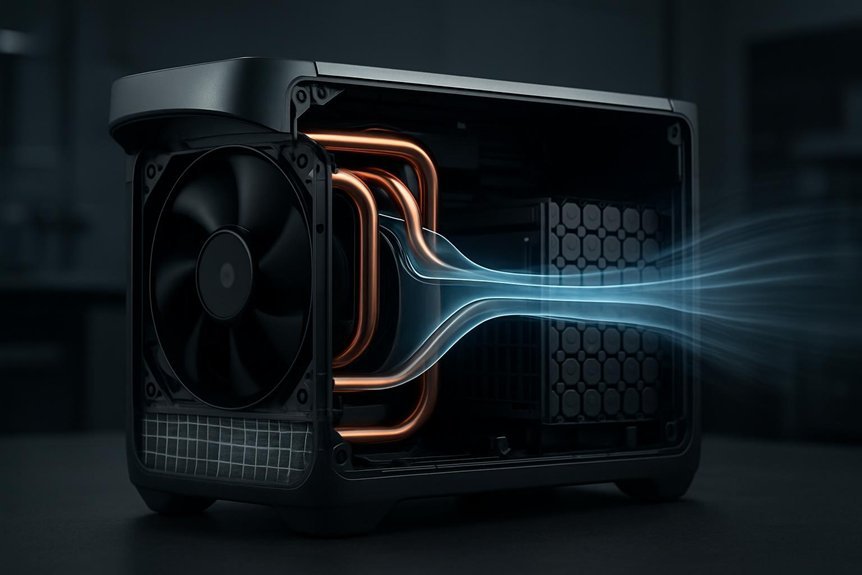
We assess how Fan Placement Strategy, Ducting Airflow Optimization, and Thermal Sensor Guidance interact to manage heat removal efficiently. We’ll specify exact fan positions, channel airflow with minimal bends, and align sensors to verify temperature trends and cooling effectiveness. Our approach emphasizes measurable criteria, repeatable setups, and clear guidance for consistent cooling performance.
Fan Placement Strategy
How should we position fans and route air to maximize cooling without compromising portability? We begin with symmetrical intake and exhaust, selecting high-flow, low-profile units. We place intake vents away from heat sinks and cords, ensuring unobstructed grille paths. We align fans to promote a direct axial flow across hottest components, then channel exhaust toward rear or top vents to facilitate natural convection. We assess thermal load hotspots via hotspot mapping, guiding placements to intercept peak temperatures without creating dead zones. Ducting airflow optimization is limited to internal routing that minimizes sharp bends and friction losses, preserving compact form. We validate with measured temps under peak load, iterating placements to balance cooling efficiency with weight and size constraints.
Ducting Airflow Optimization
What concrete steps can we take to optimize ducting for active cooling without adding bulk? We approach ducting airflow with a systematic mindset: map heat sources, route air paths, and minimize bends. Use smooth, radius bends to reduce turbulence and pressure losses, and align ducts with fan discharge for direct coupling. Select lightweight, rigid materials with low thermal expansion to maintain seal integrity under vibration. Seal joints precisely to prevent leakage and recapture expelled heat. Integrate ducts near high-heat components, exploiting natural convection corridors for passive cooling when possible. Size ducts to match fan capacity, avoiding over- or under-pressurization. Employ modular, adjustable outlets to tune flow in real time, ensuring efficient ducting airflow while preserving portability and enabling passive cooling when workload allows.
Thermal Sensor Guidance
When guiding thermal sensor deployment for active cooling, we prioritize accuracy, repeatability, and real-time responsiveness. We specify sensor types, placements, and sampling rates to capture meaningful airflow and surface temperature dynamics. Small data sets won’t suffice; we aggregate measurements across cycles to establish baseline behavior and detect drift. Placement targets include hot spots on power electronics, battery modules, and duct interfaces, with symmetric coverage for ducted paths. We use spectral analysis to distinguish periodic fan-induced fluctuations from transient events, enabling tuned control thresholds. Calibration occurs under representative load profiles, ensuring consistent readings despite ambient variation. Sensor fusion pairs thermocouples with fast-response RTDs where needed, maintaining redundancy. We document installation schemas, validation tests, and trigger conditions to sustain robust, responsive cooling performance.
PCM and Heat Pipes: Thermal Technologies Explained
Do PCM (phase-change material) and heat pipes really boost portable power stations? We assess how pcm systems store latent energy and shift heat away from hotspots, smoothing output during high demand. Phase-change materials absorb substantial energy at nearly constant temperatures, delaying component warming and reducing thermal cycling. We then examine heat pipes, which rely on capillary action and phase change to transport heat with minimal temperature drop, delivering rapid, bidirectional transfer between source and sink. Together, these technologies offer targeted thermal buffering and improved surface temperature management, allowing components to operate closer to their rated specs without short-term spikes. Our analysis emphasizes integration: material selection, contact interfaces, and passive-to-active coordination. In practice, combined pcm systems and heat pipes support steadier performance and design flexibility.
How Cooling Choices Affect Battery Health, Safety, and Performance
Cooling choices directly influence battery health, safety, and performance in portable power stations. We examine how cooling strategies shape thermal bands, charge cycles, and output stability, then translate findings into actionable guidance for users. Effective cooling minimizes temperature gradients, reduces internal resistance drift, and preserves chemistry integrity, all of which support longer battery life and reliable bursts of current. Safety considerations center on preventing overheating, venting risks, and thermal runaway potential, while ensuring user-friendly operation. We assess air, liquid, and phase-change approaches for heat transfer coefficients, system resilience, and failure modes, avoiding non relevant discussion ideas. By aligning cooling design with operating envelopes, we optimize performance, prolong life, and lower maintenance needs, delivering predictable, safe, and efficient power delivery.
Design for Compact Enclosures: Use-Case Driven Strategies
Design for compact enclosures demands use-case driven strategies that align thermal management with real-world operation. We adopt a methodical approach to minimize volume while preserving performance, reliability, and safety. Our framework translates user scenarios into explicit design constraints, guiding layout, airflow, and component selection. We assess housing geometries, connector placements, and seal integrity to prevent thermal bottlenecks. Material compatibility informs choice of polymers, metals, and coatings to sustain temperatures without degradation. We prioritize modular cooling paths that adapt to varying loads and environments, reducing parasitic heat generation. Trade-offs are documented, enabling repeatable validation.
- Define use-case based temperature targets and margins.
- Map thermal paths to enclosure geometry and materials.
- Verify compatibility between cooling elements and enclosure components.
Troubleshooting Common Pitfalls in Thermal Design
We’ll start by mapping hotspots and tracing the thermal paths to reveal where resistance concentrates. By identifying hotspots and optimizing the thermal path, we can prevent bottlenecks that slow heat removal. This focused approach sets the stage for practical diagnostics and corrective actions.
Hotspot Mapping
Where do hotspots most often arise in portable power stations, and how can we map them effectively? We approach hotspot mapping with a disciplined workflow, identifying likely concentration zones before testing. We quantify thermal hotspots by running steady-state and transient tests, then plot temperature contours and delta-T relative to ambient. This lets us pinpoint under-ventilated areas, crowded components, and board-level heat sources.
- Prioritize data collection from high-current paths and power conversion stages
- Use calibrated sensors and Infrared thermography to visualize hotspots
- Validate with repeatable, environment-controlled sweeps and compare against design targets
Effective hotspot mapping guides corrective actions, informs cooling adjustments, and reduces risk of thermal-induced failures.
Thermal Path Optimization
Are we leaving any thermal path unchecked when troubleshooting a portable power station? We approach Thermal Path Optimization with a disciplined, stepwise method. We map the complete thermal path from source to ambient, identifying primary and secondary heat flows, interfaces, and resistance sources. We verify material properties, contact pressures, and mounting orientations within a compact enclosure to ensure consistent conduction paths. We quantify thermal resistance using measurements and simulations, then prioritize corrective actions by impact on critical components. We redesign or adjust interfaces, throttling mechanisms, and heat transfer surfaces only after confirming their effect on the overall path. We validate with repeatable tests across operating loads, documenting deviations and improvements. This rigorous, repeatable process minimizes hotspots and ensures reliable, predictable cooling performance.
Frequently Asked Questions
How Do Ambient Temperatures Affect Portable Power Station Cooling Efficiency?
Ambient temperatures affect cooling efficiency: higher ambient heat reduces our cooling performance, while cooler environments improve it. We analyze ambient effects, monitor airflow, and adjust duty cycles to maintain safe temperatures, ensuring consistent power delivery and system reliability for you.
What Are Hidden Heat Sources Beyond Batteries and PSUS?
We uncover a truth: hidden heat sources include internal wiring and power module heat dissipation beyond batteries and PSUs. We analyze rigorously, noting how tight tolerances and insulation flaws amplify temps, and we advise proactive, precise thermal monitoring.
Which Thermal Metrics Matter Most for Real-World Use?
We measure heat transfer rates and peak thermal stress to assess real-world performance. We prioritize sustained temperatures, gradients, and transient spikes, because these determine reliability, efficiency, and safety under varied load and ambient conditions.
How Does Cooling Impact Charging Speed and Cycle Life?
We’ve tested the theory that cooling boosts charging speed and cycle life: better cooling efficiency reduces thermal throttling, letting chargers push currents safely, improving cycles and faster fills—yet diminishing returns emerge beyond optimal cooling.
Can Cooling Design Influence Device Weight and Cost Trade-Offs?
Cooling design does influence device weight and cost tradeoffs. We’ll analyze cooling weight tradeoffs and cost temperature optimization, quantifying impacts, evaluating materials and configurations, and presenting a precise method to balance thermal performance with weight and expense for readers.
Conclusion
We optimize thermal management by combining passive sinks with targeted active cooling, mapping heat flow to pinpoint hotspots and minimize resistance. We balance PCM buffering, heat pipes, and intelligent sensing to validate performance under realistic loads. Our design choices—layout, materials, and modular cooling—safeguard battery health and safety while fitting compact enclosures. In short, a disciplined, data-driven approach keeps temperatures controlled, reliability high, and performance consistent, like clockwork under load.