We look at surge protection and overload management as a coupled safeguard for your home, balancing fast-acting devices with steady demand controls. We’ll review how proper SPD ratings, coordinated breakers, and smart panels reduce transient hits and nuisance trips alike, while load budgeting prevents overstress. The payoff is clearer reliability and measurable ROI, but the choices we make now shape outcomes when the next transient or spike hits—so we should map a practical plan together.
Key Takeaways
- Implement layered protection: main SPDs, breakers, and smart panels coordinated to protect both distribution and connected loads.
- Assess surge ratings and response: clamping voltage, joule rating, and fast response to match load profiles.
- Plan placement and coverage: service entrance, subpanels, and critical circuits with proper grounding and routing.
- Prioritize high-risk loads: segment high-draw appliances and stagger usage to prevent nuisance trips and outages.
- Monitor and document: track surge events, panel coordination, MTBF, and update thresholds after maintenance.
What Surge Protection Guards Protect Your Home
Surge protection guards everything connected to our home’s electrical system, so identifying what they protect helps us pick the right devices. We focus on the main feeders, outlets, and appliances that rely on stable power, since protection is only as effective as its coverage. Our goal is to prevent irreversible outages that can occur when surges strike critical infrastructure like HVAC controls, sump pumps, and safety systems. We assess equipment sensitivity, voltage tolerance, and response time to choose devices that coordinate with our panel and downstream power strips. Weather forecasting informs our maintenance timing, enabling preemptive protection before predicted storms. We document surge ratings and installation locations, ensuring clear, practical guidelines that minimize disruption and maximize reliability across the entire home.
How Electrical Surges Happen and What They Threaten
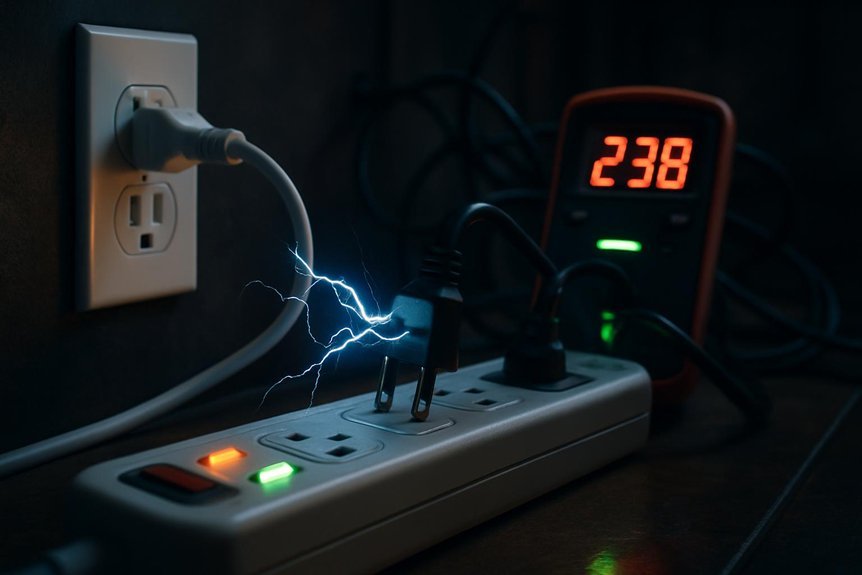
We’ll outline how electrical surges start, from brief, high-energy events to sustained disturbances that ripple through a house. We’ll identify the common spark points—power line transients, switching events, and equipment faults—that threaten essential components like breakers, outlets, and appliances. By mapping these causes to the parts they endanger, we can prioritize protective strategies that minimize damage and downtime.
Brief Surge Causes
What triggers a surge, and why does it matter to you? We identify brief, concrete causes that start a surge sequence: power line disturbances, switching events, and transient spikes. These events inject short-lived but high-amplitude energy into circuits, stressing devices and protections alike. We track surge timing to understand how quickly a spike arrives, peaks, and recedes, which informs both protection sizing and response expectations. We also note lightning coupling as a particular risk source near outdoor equipment or long feeders, where energy can couple onto the line even without direct contact. By recognizing these patterns, we can better position surge protection and reduce nuisance trips, safeguarding connected loads while avoiding overreaction to normal voltage fluctuations.
Threatening Electrical Components
Electrical surges threaten the components most common in our circuits—fuses, breakers, capacitors, diodes, and semiconductors—by delivering abrupt, high-energy impulses that exceed design tolerances. We see failures manifest as insulation breakdown, junction burnout, or degraded switching, forcing components into nonlinear behavior or permanent resistance changes. Diodes and semiconductors suffer from avalanche or thermal overstress, while capacitors experience dielectric upset and reduced life. Breakers and fuses may trip or blow, interrupting continuity and protecting downstream stages. These failures create reliability tradeoffs: tighter protection can add cost and complexity, yet reduces outage risk. Wiring redundancies help sustain service during faults but introduce additional paths for fault currents. Understanding these dynamics guides robust design, inspection, and maintenance strategies that balance protection, cost, and reliability.
Core Protection Components: Breakers, SPD, and Smart Panels
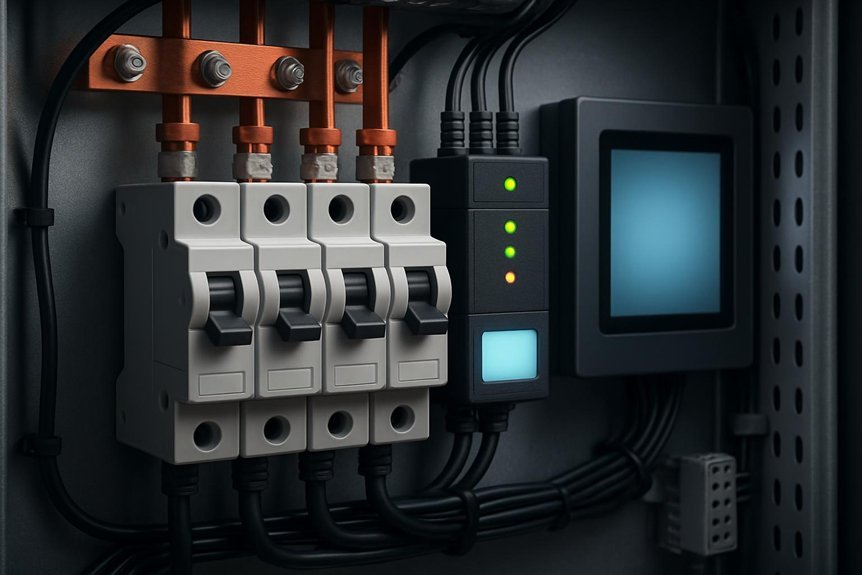
We’ll outline how Breakers form our protection strategy, how SPD performance metrics guide reliability, and how Smart Panels integration streamlines control. This discussion translates metrics into practical selection and coordination for real-world protection. By framing these components together, we highlight clear paths to safer, more responsive electrical systems.
Breakers Protection Strategy
Breakers protection strategy hinges on coordinating core protection components—breakers, surge protective devices (SPDs), and smart panels—to guard both the electrical distribution and connected loads. We design our approach around clear roles: breakers detect overcurrent, SPDs clamp transient overvoltages, and smart panels coordinate responses and visibility. In practice, we set thresholds that reflect circuit demand, equipment sensitivity, and risk exposure, then implement a layered response that prioritizes critical loads during faults. Emergency shutdowns are planned, tested, and rehearsed so operations remain predictable under duress. Apline protection informs our zoning and grounding strategy, ensuring fast isolation with minimal arcing and harmonized backfeed prevention. We document trip curves, coordination tables, and settings, enabling rapid diagnostics and consistent performance across installations.
SPD Performance Metrics
How do we quantify SPD performance within a system of breakers and smart panels to guarantee robust protection and quick recovery? We approach SPD metrics with clear, measurable criteria that reflect real-world conditions. Key figures include surge current withstand, clamping voltage under specified current, and energy absorption (let-through) limits. We assess response time, distinguishing fast short-circuit transients from slower waveform distortions that affect downstream electronics. Reliability is evaluated through failure modes, maintainability, and thermal rise under repetitive events. Surge testing provides controlled, repeatable validation of protection margins and coordination with breakers. We track coordination curves to ensure selective tripping and minimal nuisance outages. Data-driven dashboards summarize percentile performance, mean time between failures, and field incident correlations, enabling iterative design improvements without overengineering protection.
Smart Panels Integration
Are we maximizing protection harmony when integrating smart panels with core protection components—breakers and SPDs—into a cohesive system? We address how smart panels enable centralized control, faster diagnostics, and coordinated tripping, while preserving SPD protection. Our focus is integration basics: aligning breaker ratings, ensuring proper remote communication, and validating load sequencing to prevent nuisance trips. The approach minimizes impedance, enhances fault visibility, and maintains arc-fault and ground-fault protections. We assess data exchange, firmware compatibility, and safety interlocks to prevent misconfiguration. By design, smart panels should complement SPDs, not override them, preserving surge resilience. Practical steps include verifying labeling, conducting coordinated testing, and documenting firmware versions for future updates.
| Topic | Benefit | Action |
|---|---|---|
| Communication | Faster diagnostics | Check compatibility |
| Coordination | Reduced trips | Test sequencing |
| Safety | Maintains protections | Update labels |
Choosing Surge Protectors: Ratings, Placement, Coverage
Choosing surge protectors hinges on ratings, placement, and coverage. We evaluate devices by surge current rating, clamping behavior, and response time, then match to our load profile. Placement matters: main panels, subpanels, and point-of-use protectors each serve different risk points. Coverage requires understanding service entrance protection, distribution protection, and any critical circuits. We consider insulation efficiency implications, ensuring components don’t bottleneck transient dissipation or heat buildup. We also assess arc fault considerations to prevent secondary damage during surges. Our selection process blends data with installation practicality to maximize reliability and minimize nuisance trips.
- Surge rating and clamping thresholds
- Joule rating, energy handling, and service continuity
- Point-of-use vs. main-panel deployment
- Wiring, grounding, and bonding compatibility
- Verification, testing, and inspection routines
Mastering Load Management: Balancing Circuits for Reliability
Effective load management starts with a clear picture of how our circuits draw power and where the bottlenecks lie. We map loads, identify peak demands, and quantify contributions from continuous versus intermittent devices. Our goal is to balance circuits to prevent nuisance trips and extend panel life. We apply overload budgeting to allocate safe margins per branch and avoid overloading any single run. We segment high-draw appliances, staggering usage or relocating them to underutilized circuits. We also enforce panel hygiene, removing dust, inspecting breakers, and ensuring clean, solid connections to minimize resistance and heat buildup. Practical steps include documenting circuit roles, labeling clearly, and reviewing quarterly to adapt to changed loads. This disciplined approach strengthens reliability without invasive rewiring.
Practical Wiring and Panel Design for Everyday Homes
- Plan locations for main service, subpanels, and convenient access
- Use standardized conductor sizing and color coding for clarity
- Bond grounding terminals and verify continuous paths
- Group loads by priority to manage overloads gracefully
- Document circuit labeling and panel schedules for troubleshooting
We emphasize neat, reachable wiring runs, proper clearance, and protective enclosures. Our method reduces nuisance trips and simplifies inspections, improving reliability without added complexity. By integrating insulated conductors and solid grounding bonds, we create a resilient, maintainable panel design that serves daily use and occasional expansion.
Surge Protection Myths: What’s Really True
Are surge protections as critical as they sound, or are common myths just noise masking real risks? We’re cutting through assumptions to clarify what’s true. First, surge myths often inflate risk estimates without considering actual surge behavior or equipment ratings. In practice, protection limits matter: a device’s clamping voltage, response time, and joule rating determine effectiveness against typical surges. No single solution covers all scenarios, so we combine properly sized surge protectors with good grounding and equal protection across circuits. We should beware overreliance on consumer-grade devices that promise universal protection; they can be outpaced by large spikes. Real-world reliability rests on correct installation, regular inspection, and matching protection to load profiles. In short, informed choices beat marketing claims every time.
Detecting Problems: Monitoring and Diagnostics
We monitor thresholds and set alerts to catch anomalies early, so you’re alerted before minor signs become costly outages. Our diagnostics focus on surge events, capturing waveform data and fault codes to pinpoint causes quickly. We’ll also track trends over time to reveal persistent issues and guide preventative actions.
Monitoring Thresholds And Alerts
Thresholds are the backbone of effective surge protection; by setting clear, data-driven limits, we can detect anomalies before they escalate. We, as readers, rely on calibrated thresholds to trigger timely alerts and sustain system integrity. Our approach blends quantitative targets with actionable responses, ensuring decisions stay grounded in evidence rather than fear. We also consider user experience, balancing functionality with panel aesthetics to avoid distraction. Key practices:
- Define acceptable variance ranges for load and voltage
- Implement multi-sensor verification to reduce false alarms
- Tie alerts to a clear escalation protocol
- Regularly review surge budget against actual events
- Calibrate thresholds after maintenance for accuracy
Diagnostics For Surge Events
Diagnostics for surge events hinges on real-time visibility and swift confirmation of anomalies. We adopt a practical approach, outlining the data we collect, how we validate it, and what it signals. Our monitoring framework emphasizes waveform capture, event timestamps, and envelope analysis to distinguish genuine surges from noise. We prioritize clear criteria for triggering investigations, such as voltage overshoot, duration, and repetitive patterns. We verify sensor health, ensure proper grounding, and confirm data integrity before drawing conclusions. In our generic discussion, we separate unrelated topic noise from actionable indicators, preventing distraction by irrelevant readings. We document findings with concise summaries, guiding immediate containment actions and post-event reviews. Our diagnostics emphasize repeatable methods, reproducible results, and transparent reporting to readers.
Fault Diagnosis And Trends
How do we spot faults early and keep systems reliable? We approach fault diagnosis as a data-driven task, combining real-time sensing with historical trends analysis to reveal anomalies before failures occur. We parse event logs, capture transient behaviors, and correlate surges with equipment health indicators to distinguish true faults from noise. Our goal is actionable insight, not buzzwords, so we prioritize clear metrics, thresholds, and repeatable procedures. By tracking evolving patterns, we can forecast degradation and schedule targeted maintenance. This disciplined monitoring supports rapid containment and minimal disruption when faults arise.
- Real-time sensing and log correlation
- Baseline establishment and deviation detection
- Trend analysis for degradation forecasting
- Root-cause identification with repeatable checks
- Proactive maintenance scheduling based on data
Costs, Savings, and ROI of Proactive Protection
Proactive protection pays for itself by preventing costly outages, equipment damage, and Downtime. We quantify value through costs savings, roi assessment, and tangible reliability gains that matter to operators and homeowners alike. By modeling failure risks against preventive investments, we show how installation costs are offset by reduced repair bills, fewer production losses, and extended asset life. System reliability improves as protective devices mitigate transient events and surge spikes that would otherwise cascade through power rails. We compare upfront capital against long-term operating savings, highlighting payback periods and total cost of ownership. While nuances exist across environments, the principle remains: disciplined protection yields measurable returns, clearer budgets, and diminished uncertainty. Our analysis prioritizes data-driven decisions over anecdotal assumptions.
How to Implement a Starter Protection Plan at Home
A practical starter protection plan at home builds on the savings and risk reductions we quantified earlier by focusing on reliable, affordable steps. We outline a pragmatic path, prioritizing essential actions that deliver measurable protection without complexity. Our approach keeps systems simple, verifiable, and adaptable as needs change.
- Define critical circuits and label them for quick isolation
- Install (or upgrade) a whole-home surge protector where feasible
- Use reputable surge-rated power strips for high-demand devices
- Implement a maintenance schedule and test plan
- Track outages, loads, and device responses to refine the plan
These subtopic ideas help structure implementation while staying unrelated to other h2s. We stay concise, data-driven, and actionable.
Frequently Asked Questions
How Do Surge Protectors Differ Across Home Electrical Panels?
Surge protector differences stem from panel compatibility and protection ratings. We tailor choices to breaker types, service capacity, and wiring configurations, ensuring proper grounding. We assess clamp voltages, Joule ratings, and response times for each panel.
What Is a Joule Rating and Why It Matters?
A joule rating measures how much energy a protector can absorb before failing, and it matters because higher ratings mean better surge endurance. We’ll compare options, noting Surge significance and Joule rating, guiding practical, precise protection choices for your system.
Do Surges Affect Electronics in Standby or Sleep Mode?
Yes, surges can affect electronics in standby or sleep mode, though damage is less likely than during active use. Standby power devices still draw current, and sudden transients can penetrate, prompting protective designers to emphasize robust circuitry and filtering for electronics standby.
How Can I Tell if My SPD Has Degraded Performance?
We can tell if our SPD’s degraded by running SPD health checks, noting weak test indicators, and following troubleshooting tips; our assessment steps reveal performance changes, including nuisance trips or delayed protection, guiding precise actions for maintenance and replacement.
Are There Monthly Tests or Maintenance Tasks for Protection Devices?
We perform monthly tests and maintenance tasks on protection devices to guarantee reliability, promptly spotting degradation, firmware updates, contact cleanliness, and connection integrity, while documenting results for trend analysis and scheduling any necessary replacements or recalibrations.
Conclusion
We’ve seen how surge protection and overload management guard our homes, coordinating breakers, SPDs, and smart panels to curb transient energy and sustained demand spikes. By auditing loads and staggering high-draw appliances, we improve reliability and extend asset life. So, what’s our bottom line: are we actively protecting critical circuits with proper ratings, placement, and monitoring? With disciplined planning, clear documentation, and proactive diagnostics, we reduce outages and realize measurable ROI. Let’s implement a practical starter protection plan today.