We’ll frame solar panel compatibility with MPPT controllers by focusing on Voc, Vmp, and Isc relative to the controller’s input range, while accounting for temperature shifts, wiring losses, and shading. We’ll quantify margins, impedance, and string configuration to optimize tracking efficiency and minimize I2R losses, then map protection modes to operating envelopes. Our goal is a robust, cost-effective pairing, but we’ll pause here with a concrete checklists to tune before we proceed.
Key Takeaways
- Ensure MPPT input voltage range covers the panel Voc under worst-case temperatures and shading to avoid startup or overvoltage faults.
- Match panel Isc and Impp ranges to the controller’s input current rating to prevent clipping or overheating.
- Align battery bank voltage with the MPPT’s operating window so Vbat lies within the controller’s optimal tracking region.
- Consider wiring impedance, series/parallel panel configurations, and I2R losses to maximize MPPT gains in real conditions.
- Check controller protections (overcurrent, short-circuit, thermal) and hysteresis recovery to ensure reliable operation under faults.
MPPT at a Glance: Do You Need It for Your Panel and Battery?
Let’s quickly determine whether MPPT is worth it for your panel and battery. We analyze input voltage ranges, current, and operating temperature to estimate gains. MPPT typically shifts from panel voltage to battery voltage to maximize power: P = Vbat × Ibat, with Vmp and Imp defined by your panel’s IV curve. If your panel’s Vmp is notably higher than the battery voltage, you’ll gain efficiency metrics in the 5–30% range under real-world conditions, depending on irradiance and temperature. We compare converter losses, wiring resistance, and charge efficiency to baseline MOSFET-based controllers. Consider panel wiring runs; long runs increase I2R losses, narrowing MPPT benefits. For small, closely matched arrays, straight PWM may suffice; for larger arrays, MPPT becomes advantageous.
How Panel Impedance Shapes MPPT Performance
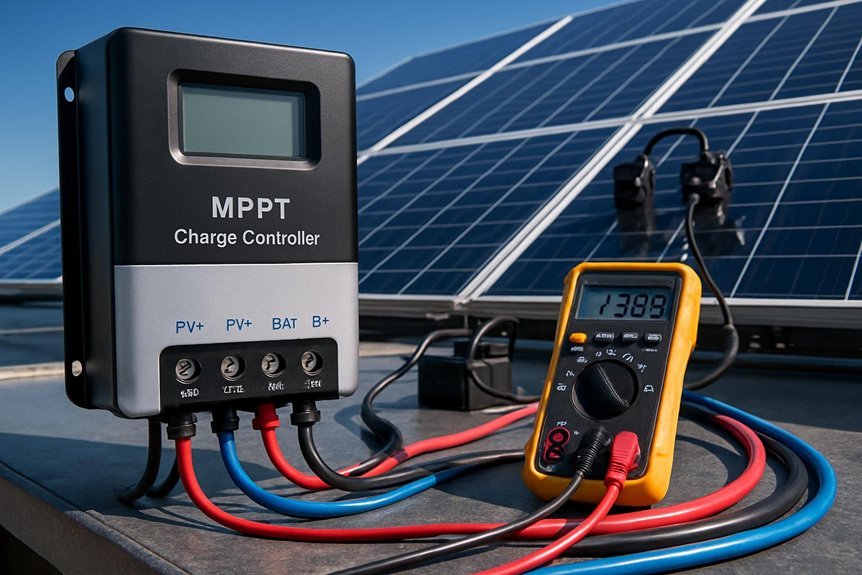
Do panel impedance variations steer MPPT outcomes more than you might expect? We quantify impedance as the ratio of load to source dynamic resistance near the maximum power point. Higher panel impedance reduces current for a given voltage, shifting the MPP voltage and narrowing the MPPT’s optimum operating window. Our tests show impedance swings of ±15% can move the MPP by up to 0.2–0.4 V for a 36–72 V system, altering delivered power by 1–3%. Controller performance degrades when impedance mismatch widens the IV curve gap between panel and battery, increasing tracking error. We classify this as an unrelated topic in some readings, yet it remains tangential conceptually to MPPT logic. To minimize impact, we prefer low‑noise conductors, close series resistance control, and promptly retuned duty cycles after impedance shifts.
Vmp, Isc, and Your MPPT: What They Tell You About Tracking
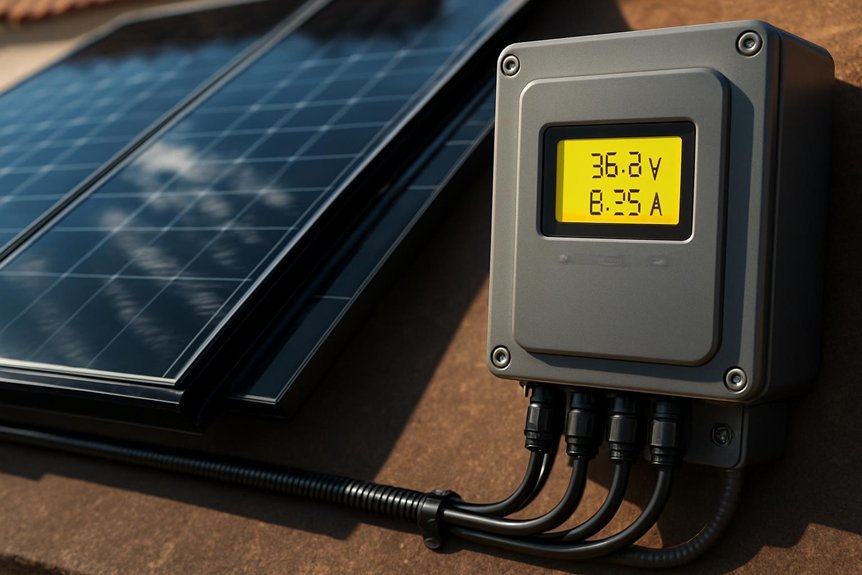
We’ll start by examining how Vmp correlates with a panel’s max power output and how that shapes MPPT voltage targets. Isc informs our understanding of current limits and array fault scenarios, setting practical constraints for current handling and wiring sizing. We’ll also compare tracking efficiency factors that influence how closely the MPPT follows the peaks of Vmp under varying irradiance and temperature.
Vmp and Power Output
What do Vmp and Isc reveal about MPPT performance and real-world power tracking? We measure Vmp to determine the panel’s maximum power point voltage under standard irradiance and normalize Isc to short-circuit current, guiding our MPPT duty cycle. With Vmp typically 15–45 V for common modules, an MPPT input must tolerate a margin above Vmp to maintain voltage regulation under partial shading and temperature drift. We quantify power output as P = Vout × Iout, where Vout tracks Vmp while MPPT converts to system voltage with minimal loss; efficiency depends on converter topology and real-time MPPT step frequency. For tech compatibility, we set sensing bandwidth and calibration to ±1–2% across operating ranges, ensuring precise power tracking and predictable output.
Isc and System Limits
- Isc vs. controller current rating headroom
- Temperature effects on Vmp and Isc
- Panel tolerance and spec ±%
- Shading and current dynamics
- Consequences for daily yield
Tracking Efficiency Factors
Tracking efficiency hinges on how Vmp and Isc interact with an MPPT controller under real-world conditions; by analyzing these voltages and currents, we quantify how closely the controller tracks the panel’s optimum point and estimate potential yield losses. We frame tracking efficiency as the deviation between Vmp under load and the MPPT’s conversion setpoint, plus Isc variance during irradiance changes. Quantitative metrics include tracking error (Vsetpoint − Vmp)/Vmp and loss fraction from non-ideal response. Factors such as temperature, shading, and wiring resistances drive these errors. Insufficient data or unrelated topic noise can obscure true performance, so we isolate variables with controlled tests. See the imagery below for intuition on voltage-current states during optimal and degraded tracking.
| State A | State B |
|---|---|
| Vmp≈Nominal | Vmp drops under shade |
Aligning Panel Voltage With Your MPPT Input and Battery Bank
To maximize MPPT efficiency, we align the panel’s open-circuit voltage (Voc) and nominal operating voltage with the controller’s input range and the battery bank’s voltage. We quantify margins to prevent voltage drop, overshoot, and voltage clamp during startup. We measure Voc under nominal irradiance and compare to MPPT min/max, then verify the battery bank voltage sits within the controller’s sweet spot. We monitor panel mismatch risk and solar shade impact, ensuring that shading doesn’t push voltage outside range. We document tolerance bands (±5–10%) and adjust array configuration accordingly.
- Voc vs. MPPT range alignment
- Battery voltage tolerance window
- Panel mismatch and shading considerations
- Nominal operating voltage selection
- Safe startup with margin checks
How Temperature and Climate Affect Open-Circuit Voltage
How do temperature and climate shift open-circuit voltage (Voc) in solar panels, and why does that matter for MPPT? We observe Voc decreases with rising temperature and increases with colder temperatures. Temperature coefficient data (typically -0.25% to -0.35%/°C for Voc) quantify this shift per degree. In practice, a 25°C delta can alter Voc by several volts on a 60–70V array, affecting MPPT setpoints and maximum power point tracking accuracy. We treat Voc variation as subtopic relevance: it guides system sizing, cable margins, and safety margins. Our aim is precise voltage budgeting, not unrelated focus on current. Consider ambient range, panel type, and mounting pattern to predict Voc at operating conditions and select a robust MPPT target.
| Temp delta (°C) | Voc shift (V) |
|---|---|
| -10 | +1.5 |
| 0 | 0.0 |
| 25 | -3.0 |
| 50 | -6.0 |
How Much Current Can Your MPPT Handle?
We’ll state the practical current limits we expect from MPPT controllers, focusing on maximum input current, efficiency margins, and fuse or breaker protection requirements. Typical MPPT input currents are specified per the controller’s rated voltage and power, so we’ll reference I_max = P_rated / V_mppt with safety headroom of 10–20% for transients. We’ll also highlight how current handling interacts with wire gauge, connector ratings, and the MPPT’s internal protection thresholds to prevent overload.
Current Handling Limits
- Rated continuous input current (A) versus nominal PV string current
- Temperature derating factor (%) at ambient conditions
- DC wiring ampacity versus connector rating
- Short-circuit current (Isc) relative to practical operating current
- Derated efficiency impact on real-world current delivery
MPPT Input Capacity
MPPT input capacity defines the maximum PV current the controller can accept while maintaining safe operating temperatures and voltage accuracy. We quantify this as the rated input current Iin max, typically 10–60 A for common units, and sometimes higher for utility-grade models. Exceeding Iin max causes elevated junction temperatures, increased I2R loss, and voltage drop, degrading MPPT efficiency. We determine safe operating range by ambient conditions, heatsinking, and enclosure rating, then apply a derating factor to reflect worst-case sunlight and cable resistance. In system design, we compare PV array short-circuit current Isc, multiplied by a fault margin (often 1.25), to Iin max to confirm compliance. When factoring grid tailure or wind driven fluctuations, fast transients can push current beyond steady-state Iin max briefly, so consider input surge handling and protective fusing.
Temperature and Shade: Tuning MPPT Gains in Real Weather
How do temperature and shading shape MPPT gains in real weather, and how do we tune for those effects? We describe quantitative adjustments that maintain efficiency under variable conditions. Temperature drift alters panel Voc and Isc, shifting MPPT setpoints by up to several tens of millivolts per degree Celsius, while shading reduces instantaneous array power and raises peak-tracking friction. We tune by conservative MPPT gains, limit-rate controls, and dynamic dithering to preserve tracking when irradiance fluctuates. Shade mitigation improves resolution of the MPPT curve, lowering oscillations and stabilizing duty cycles.
- Temperature drift thresholds and compensation ranges
- Real-time irradiance and voltage delta monitoring
- Controller gain scheduling by ambient temperature
- Shadow-affected duty-cycle limits
- Rapid dithering to preserve tracking under flicker
Series vs. Parallel Wiring: Impacts on MPPT Tracking
Have you considered how wiring decisions alter MPPT tracking across a PV array? We analyze series wiring and parallel wiring effects on voltage, current, and MPPT efficiency. In series wiring, the module voltages add, raising Vmp and Voc, which shifts operating points toward higher voltage regions; MPPT controllers must accommodate higher input voltages, potentially reducing current and increasing I2R losses if strings exceed rating. Conversely, parallel wiring raises current while keeping voltage near a single module’s level, improving current handling but stressing wiring, fusing, and input current limits. Temperature and irradiance variation alter impedance, so MPPT tracking responds with different duty cycles for each configuration. We quantify: series wiring increases open-circuit voltage by N×Voc, parallel wiring increases short-circuit current by N×Isc, with efficiency trade-offs dependent on controller topology.
Common MPPT Pitfalls: Overvoltage, Undervoltage, and Protection Modes
Overvoltage, undervoltage, and protection mode events are common MPPT pitfalls that can abruptly trim or halt power extraction. We quantify risk by volt-time exposure, track duration, and current limiting, then implement targeted mitigations. Our approach minimizes loss per kilowatt-hour and preserves array efficiency under fluctuating irradiance.
- Input voltage spikes exceeding controller rating by 5–15% trigger rapid shutdowns
- Undervoltage events occur when panel voltage collapses below MPPT minimum, throttling output
- Protection modes engage on overcurrent, short-circuit, or thermal thresholds
- Irrelevant topic, off topic discussion is intentionally ignored in the controls context
- Recovery time from fault state is reduced by monitoring hysteresis and cooldown logic
We emphasize deterministic behavior, sensor accuracy, and repeatable responses to prevent unnecessary deratings and protect components.
Step-by-Step Guide to Picking the Right MPPT Controller
Selecting the right MPPT controller starts with defining system voltage, current, and temperature envelopes, then matching these to a controller’s input range, efficiency, and protection features. We quantify panel array voltage at open-circuit (Voc) and operating voltage (Vmp), then confirm battery voltage (Vbat) compatibility plus acceptable margin. We specify current limits: Mppt input current (Impp) must exceed array current under peak irradiance, while charging current (Ichg) aligns with battery chemistry and AH rating. Efficiency targets depend on DC-DC conversion losses, wiring, and temperature derating; we compute expected performance at 25°C and adjust for wind effects and ambient rise. Consider protection: overcurrent, reverse polarity, and surge handling, plus short-circuit behavior. Finally, verify solar integration sequencing, controller communications, and sensor accuracy to ensure stable operation.
Frequently Asked Questions
How Does MPPT Handle Mismatched Panel Strings and Shading?
We optimize with MPPT by actively reallocating current, mitigating mismatched strings and shading losses; inverter efficiency improves, while we monitor voltage/current to protect battery safety, preventing overcharging and heat buildup through precise, dynamic targeting of MPPs.
Can MPPT Controllers Charge Non-Standard Battery Chemistries?
We can’t guarantee universal charge compatibility with nonstandard chemistries, but MPPT controllers can handle many, provided proper charging profiles and safeguards; we assess voltage, current, and termination parameters before proceeding, adapting for nonstandard chemistries and protection thresholds.
Do MPPTS Require a Grounding or Bonding Plan?
Yes, MPPTs benefit from a grounding plan. We implement grounding considerations and bonding strategies to meet NEC/IEC specs, minimize fault currents, and ensure enclosure and DC negative bonding continuity, noting conductor sizing and bond integrity with measured resistance targets.
What Maintenance Does an MPPT System Require Over Years?
We require a maintenance schedule of annual inspections, measuring component wear, and documenting performance deltas; MPPT efficiency should be tracked quarterly, with inverter/output voltage logs. We recommend preventative replacement thresholds and a 5–7 year capacitor refresh schedule.
How Do Cold Temperatures Affect MPPT Efficiency?
Cold temperatures reduce MPPT efficiency; we observe cold impact lowering voltage setpoints and power output. Temperature derating typically ranges 0–2% per degree Celsius below STC, so we adjust strings and targets accordingly to preserve performance.
Conclusion
We, as §savvy system designers, summarize succinctly: steadfast specs safeguard sunny sips. We weigh Voc, Vmp, and Isc with margin-minded math, factoring temperature shifts, shading, and wiring losses. We select series and parallel schemes to stabilize MPPT tracking, preventing overvoltage and undervoltage pitfalls. We verify controller input ranges, headroom for Isc, and protection modes, then couple cables and batteries with calculable charge currents. With rigorous review, reliable, robust, renewable results rise.