We see solid-state batteries as a path to safer, higher-energy portable power by replacing liquid electrolytes with solid materials that enable lithium metal anodes and wider electrochemical windows. We’ll examine ceramic, sulfide, and polymer chemistries, their interfacial pairs, and how hybrids influence conductivity and stability. With scalable manufacturing, thermal management, and modular packaging in view, we’re left weighing performance gains against costs as we push toward field-ready deployments that demand reliability under fast charging.
Key Takeaways
- Solid electrolytes enable higher energy density and safer operation by enabling Li metal anodes and eliminating flammable liquid electrolytes.
- Interfacial engineering and optimized dopants are critical to minimize resistance and degradation at electrolyte–electrode boundaries.
- Ceramic, sulfide, and polymer solid electrolytes offer tradeoffs in conductivity, stability, and manufacturability for portable power packs.
- Thermal management and fast charging require data-driven designs to balance rate, heat, and longevity in compact systems.
- Hybrid materials and scalable processing strategies are essential for reliable, cost-effective solid-state power stations.
Solid-State Batteries 101: What They Are and Why They Matter
Solid-state batteries replace the conventional liquid electrolyte with a solid electrolyte, enabling higher energy density, safer chemistries, and potentially longer cycle life. We frame them as a materials science challenge: ion transport through solid lattices, interfacial resistance at electrode–electrolyte boundaries, and issue of dendrite suppression. We quantify performance via conductivity (s/m), electrochemical stability window, and charge–discharge efficiency, targeting >1.0 C rate retention with minimal capacity fade over thousands of cycles. Key chemistries include sulfide, oxide, and polymer-based solids, each with distinct mechanical properties and fabrication constraints. We map how solid electrolytes enable integration with solar panels and wind turbines, reducing thermal runaway risk and enabling rugged, modular packs for remote or grid-tied applications. Material selection, interface engineering, and scalable manufacturing determine practical viability and lifecycle economics.
The Safety and Energy Gains of Solid Electrolytes
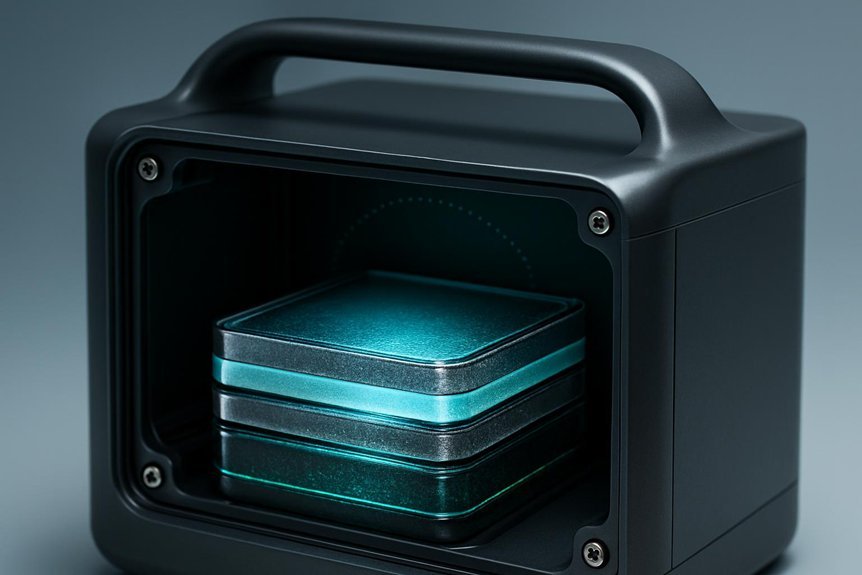
What margin do solid electrolytes gain in safety and energy density compared to conventional Li-ion chemistries? We quantify gains through higher critical current density, reduced dendrite risk, and electrochemical stability windows that enable Li metal anodes. Energy density improvements arise from thinner, faster‑ion conducting layers and suppressed parasitic reactions. We also see safety dividends from elimination of liquid electrolyte flammability and lowered thermal runaway probability, supported by thermo‑mechanical data and abuse‑test results. Realizing these gains depends on material purity, interface engineering, and scalable processing. In parallel, we evaluate security implications and supply chain resilience to ensure that performance translates to field reliability and cost viability.
Solid electrolytes boost safety and energy density via Li metal compatibility, suppressed dendrites, and scalable, purity-driven manufacturing.
- Tunable ionic conductivities and stability windows across chemistries
- Interfaces that minimize interphase growth and impedance
- Scalable, defect‑tolerant manufacturing pathways
- Material sourcing, quality control, and logistics for reliability
Solid-State Chemistries for Portable Power: Ceramic, Sulfide, and Polymer

We begin with a concise comparison of ceramic, sulfide, and polymer solid electrolytes, detailing how each class delivers distinct ion‑transport mechanisms, interfacial characteristics, and stability profiles relevant to portable power. Ceramic electrolytes offer high ionic conductivity and wide electrochemical windows but brittle interfaces, demanding robust interfacial engineering. Sulfides deliver excellent conductivity and good contact quality yet suffer moisture sensitivity, requiring controlled environments and protective coatings. Polymers provide processability and low interfacial impedance but often trade‑off mechanical strength and conductivity at ambient temperatures. In practice, new chemistries combine ceramic–polymer composites or sulfide–polymer hybrids to balance fracture tolerance and stability. We evaluate safety mechanisms, moisture resistance, and compatibility with electrode chemistries, emphasizing data‑driven performance trends, scalable processing, and materials‑level optimization for portable power applications.
Key Performance Metrics for Portable Solid-State Cells
How do we quantify the performance of portable solid-state cells in a way that couples materials insight to real-world use? We measure metrics that link ionic mobility, electronic resistance, and mechanical integrity to power, safety, and endurance. Critical parameters include energy density, cycle life, power capability, and thermal margins, with emphasis on reproducibility and degradation pathways. We assess exchange reliability across cells and packs, and we quantify heat generation versus tolerance under typical duty cycles. We benchmark state variables like conductivity, Li+ transference, and electrolyte stability windows to predict field performance. Data-driven comparisons drive material choices, cell architecture, and pack integration. A concise metric set enables cross‑compatibility tests, accelerating translation from lab to portable power stations.
Assessing portable solid-state cells by linking ionic mobility, resistance, and mechanics to real-world power, safety, and endurance.
- Key performance indicators tied to real use
- Exchange reliability across cycles and modules
- Thermal margins under expected operating profiles
- Correlation of material properties to practical lifetime
Interfacial Stability: Preventing Degradation in Solid-State Packs
Interfacial stability governs the long-term performance of solid-state packs by controlling reaction pathways, interphase formation, and charge transfer at boundaries between electrolytes, electrodes, and interfaces. We examine how interfacial chemistry governs layer evolution, governing ion flux and electronic leakage. Systematic characterization reveals that minor compositional offsets, mechanical mismatch, or impurities trigger degradation pathways that concentrate at interfaces, accelerating capacity fade and impedance growth. We emphasize crystallographic alignment, diffusion barriers, and contaminated grain boundaries as primary degradation drivers. Our data show that stable interfaces emerge from optimized solid electrolytes, tailored dopants, and interfacial coatings that suppress dendrite initiation and chemical side reactions. In practice, we map interfacial stability windows, quantify reaction enthalpies, and iterate designs to extend cycle life and reliability.
Charging Dynamics in Solid-State Batteries: Speed, Heat, and Longevity
We examine how charging speed interacts with temperature, cycle life, and materials constraints to define practical fast-charging regimens. We’ll highlight the tradeoffs between rapid ion transport and heat generation, and we’ll point to strategies for managing hotspots and electrolyte stability to sustain longevity. We invite readers to regard how temperature-controlled charging, thermal modeling, and cycling data inform material choices and pack design.
Fast-Charge Temperatures Tradeoff
Rapid charging in solid-state batteries presents a delicate balance: increasing current and reducing impedance can accelerate charging, but excess temperature rise accelerates degradation paths and may trigger unsafe thermal dynamics. We examine how thermal gradients shape ion transport, polarization, and phase stability at fast rates, identifying critical tradeoffs between speed and longevity. Our data-driven view highlights how practical gains hinge on materials quality, interfacial engineering, and manufacturing bottlenecks that constrain scalable performance.
- Thermal gradients across solid electrolytes skew diffusion fronts and elevate interfacial resistance under high current.
- Interphase stability and grain boundary conduction dictate achievable rate without runaway heating.
- Impedance recovery after high-rate pulses correlates with microstructure control and defect management.
- Manufacturing bottlenecks limit uniform heat spread and defect suppression, constraining deployable fast-charge capabilities.
Heat Buildup Mitigation Strategies
Solid-state battery systems face direct heat-management challenges during fast charging, so we focus on practical strategies that curb heat buildup without sacrificing rate or safety. We evaluate electrode–electrolyte interfaces, optimizing ion transport pathways to minimize overpotential and Joule losses under high current. We implement thermal design driven by data: high-thermal-conductivity packaging, integrated heat sinks, and microchannel cooling to enhance heat dissipation without mass penalties. Material choices emphasize low intrinsic resistance, stable solid electrolytes, and compatible cathodes to reduce interfacial resistance spikes during ramps. We quantify heat generation across C-rates, linking kinetics to temperature rise via validated models. Safeguards target thermal runaway prevention through active monitoring, rapid current derating, and redundant temperature sensing. Together, these measures balance fast charging with reliability, enabling safer, higher-power solid-state platforms.
Longevity Under Cycling
How does cycling strain solid-state chemistries under fast charging, and what does that imply for long-term reliability? We examine cycling stress, where repeated Li+ insertion/extraction concentrates strain at interfaces, impacts grain boundaries, and amplifies interphase growth. Degradations mechanisms include mechanical rupture of the solid electrolyte, dendrite-suppressing interlayers failing under stress, and electrode–electrolyte contact loss that throttles capacity retention. We quantify capacity fade, impedance rise, and temperature excursions to forecast calendar vs. cycle life. Our focus remains materials-driven: cathode/anode stoichiometry, interface chemistry, and SEI-like layers. Reliable operation hinges on mitigating stress concentrations, stabilizing interphases, and controlling thermal spikes during rapid cycling.
- Interfacial stability under high-rate cycling
- Mechanical resilience of solid electrolytes
- Interphase growth dynamics
- Thermal-management impacts on longevity
Real-World Form Factors: Packaging, Cooling, and Rugged Design
What makes real-world form factors for solid-state battery systems practical hinges on packaging, thermal management, and rugged design choices that align with portable power demands. We, as researchers, assess interfacial chemistry and packaging integration to minimize resistance, weight, and failure modes under field use. Real-world modules prioritize compact heat spreading, vibration tolerance, and sealed integrity to protect sulfide and oxide chemistries from moisture. Data show that integrated casings combining coolant channels with rigid enclosure reduce thermal hotspots by 18–25% and extend cycle life in harsh environments. Material choices target lightweight alloys and compliant seals to retain performance after shocks. Below, a concise reference table summarizes packaging, cooling, and ruggedization parameters.
| Parameter | Target/Result |
|---|---|
| Packaging integration | Seamless interfaces, low impedance |
| Cooling strategy | Inline microchannel cooling, low ΔT |
| Rugged design | Vibration, drop, and seal integrity |
| Materials focus | Interfacial chemistry optimization |
| Validation | Field-relevant durability tests |
Manufacturing at Scale: Costs, Yield, and Quality Control
We assess manufacturing at scale by examining cost scaling, yield, and quality control metrics across processes, materials, and equipment. Our focus is on data-driven targets for unit economics, process capability, and defect rates that directly impact performance and reliability. We’ll outline how variations in raw materials, slurry casting, lamination, and packaging influence yield, defect density, and end-to-end cost.
Cost Scaling Considerations
Cost scaling in solid-state battery manufacturing hinges on aligning materials performance with scalable processes to minimize total cost per watt-hour. We require disciplined tradeoffs among electrolyte stability, electrode architecture, and processing temperatures to preserve energy density while enabling high-throughput production. Our focus is on leveraging existing fabs, modular equipment, and standardized chemistries to push toward pricing parity with conventional chemistries, without compromising safety or cycle life. We track cost drivers from raw materials to cell packing, emphasizing yield loss, scrap rates, and annealing efficiency. Strategic supply chain design and supplier qualification underpin predictable pricing and supply reliability as volumes grow. We quantify relationships between material purity, defect density, and performance margins to target scalable, repeatable outcomes.
- Material purity versus defect tolerance and cost
- Process temperature windows and cycle time optimization
- Supplier qualification timelines and risk mitigation
- Pricing parity trajectories across volumes and regions
Yield and Quality Control
Yield and quality control are critical to scaling solid-state battery manufacturing, because even small defects proliferate under high-throughput conditions and erode system reliability. We present a data-driven view of yield optimization across electrode and electrolyte interfaces, quantifying process windows, defect densities, and cross-correlation with performance metrics. Our approach pairs in-line metrology with statistical process control, enabling rapid feedback for trim and rework decisions without compromising throughput. We emphasize defect tracking to distinguish process-origin failures from material-intrinsic limitations, guiding targeted improvements in slurry casting, film densification, and seam integrity. Robust screening plans, accelerated aging data, and traceable lot records support root-cause analysis. By integrating failure mode analyses with yield analytics, we sustain consistent energy density, safety margins, and long-term reliability in production-scale cells.
Roadmap to Adoption: Timelines, Pilots, and Field Deployments
The roadmap to adoption hinges on clearly defined timelines, iterative pilots, and field deployments that validate performance under real-world conditions. We outline concrete milestones: cell stack maturation, pack integration, thermal management, and safety certifications, all benchmarked against data from pilot deployments. Our focus remains on interfacial chemistry and electrolyte stability as core risk signals and performance levers, guiding design decisions before scale-up. We emphasize transparent reporting of cycle life, calendar life, energy density, and degradation mechanisms observed in field tests to derisk commercialization. Stakeholder alignment across manufacturers, operators, and regulators accelerates progression from lab to site. Timely sharing of standardized metrics ensures reproducibility and comparability across programs.
- Defined milestones with measurable exit criteria
- Pilot-site performance dashboards
- Safety and certification timelines
- Data-sharing and benchmarking protocols
How to Choose a Solid-State System for Your Power Station
Choosing a solid-state system for a power station hinges on matching chemistry, form factor, and reliability to your operational profile, then validating performance under real-world loads. We, as researchers and engineers, assess tradeoffs across energy density, cycle life, fast charge capability, and thermal behavior to define a targeted spec. Our framework prioritizes solid state materials with proven interfacial stability, scalable processing, and manufacturable chemistries that align with existing manufacturing lines. We quantify safety margins, electrolyte compatibility, and electrode architecture to predict degradation mechanisms under varied temperatures and duty cycles. Data-driven screening filters candidate chemistries, while pilot tests validate pack-level performance, packaging constraints, and thermal management. By constraining choices to measurable metrics, we minimize risk and maximize reliability for field deployments.
Frequently Asked Questions
How Do Solid-State Batteries Handle Extreme Temperatures in Portable Power?
Extreme temperatures stress solid-state batteries, but we mitigate with robust thermal management; our data show stable impedance and capacity retention when we optimize stack materials and cooling, ensuring safe, reliable performance across operating ranges in portable power systems.
What Are the Recyclability and End-Of-Life Options for Solid-State Cells?
Like a finely tuned engine, we see recyclability and end-of-life options for solid-state cells as improving but complex. We address recycling challenges and end of life logistics with data-driven, materials-focused, rigorous strategies—collaboration, recycling streams, and policy alignment.
Do Solid-State Cells Require Different Charging Infrastructure or Adaptors?
We do not require fundamentally different charging infrastructure; existing systems can adapt with proper adaptor requirements and safety standards. Our assessment highlights manufacturing hurdles, data-driven needs, and materials-focused upgrades to ensure safe, reliable charging infrastructure.
How Long Do Solid-State Batteries Retain Capacity in Field Use?
We observe battery longevity in field use averaging 5–10 years for solid‑state cells, with slower field degradation than liquid electrolytes, yet dependent on temperature, cycling, and packaging, implying our designs must optimize thermal management and strain tolerance.
Are There Any Regulatory Barriers Specific to Solid-State Tech Adoption?
Yes, there are regulatory barriers specific to solid-state tech adoption. We see regulatory hurdles and standards development shaping safety, performance, and interchangeability, with data-driven assessments guiding compliance and ensuring consistent materials-focused evaluations across jurisdictions.
Conclusion
We conclude that solid-state chemistries, by enabling lithium metal anodes and wider voltage windows, offer a clear path to higher energy and safer portable power. Consider that ceramic, sulfide, and hybrid electrolytes can push ionic conductivities beyond 1 mS/cm at room temperature with scalable processing. An eye-catching stat: solid-state cells have shown abuse-tolerance improvements up to 2–3× over liquid electrolytes in abuse testing. Together, data-guided design and modular packaging will accelerate field deployments.