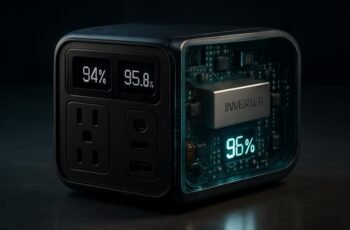
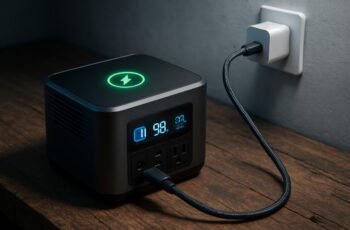
We’re looking at wireless charging as a practical upgrade path for portable power, from standards alignment to firmware validation and interoperability. We’ll outline a phased approach that balances design rigor with real-world use, focusing on coil alignment, thermal management, and smart power management. Our goal is clear—secure, scalable deployment with measurable efficiency gains—yet we’ll keep the path practical and vendor-agnostic, so you can see where the decisions lead next.
Key Takeaways
- Wireless charging integration streamlines power delivery by eliminating cords, improving user convenience and wearability across portable devices.
- Standards, validation, and certification ensure interoperability, safety, and reliable performance across devices and ecosystems.
- Alignment tolerance, coil design, and power management directly impact real-world efficiency, heat, and battery health during top-ups.
- Deployment plans should map phased rollouts, supply chain constraints, risk mitigation, and rollback strategies aligned to certification milestones.
- Practical integration patterns (surface pads, flex coils, shielded modules) enable robust, rugged, and scalable wireless charging for wearables and power banks.
Why Wireless Charging Matters for Portable Power
Wireless charging matters for portable power because it eliminates the need to plug and unplug cords, enabling quicker, cable-free power delivery in diverse environments. We evaluate how this capability changes usage patterns, device design, and reliability under real-world conditions. Our analysis identifies innovation hurdles shaping the development path, including efficiency targets, thermal management, and integration with varied form factors. We quantify startup timelines, cost implications, and failure modes that influence supplier strategies and customer expectations. We also examine user adoption, focusing on perceived convenience, compatibility concerns, and interoperability across ecosystems. By isolating constraints and measuring impact on runtime, charging latency, and chassis integrity, we establish a clear design rationale. This focus ensures practical progress while avoiding speculative gains in absence of tested, scalable solutions.
Wireless Charging Standards: A Decision Framework for Portable Devices

How do we choose a reliable wireless charging standard for portable devices, and what criteria guide a sound decision? We present a framework that emphasizes interoperability, safety, and lifecycle viability. Our approach weighs standards adoption trajectories, ecosystem support, and certification requirements to minimize risk and ensure long-term compatibility. We assess performance metrics, regulatory alignment, and supply chain stability to sustain updates and repairs. This framework guides prudent, reproducible choices for end users and manufacturers alike.
- Interoperability and ecosystem breadth
- Performance, efficiency, and heat management
- Regulatory alignment and safety certifications
- Standards adoption timelines and roadmap clarity
- Certification requirements and post-market support
Design Steps to Enable Wireless Top-Ups in Batteries and Power Banks
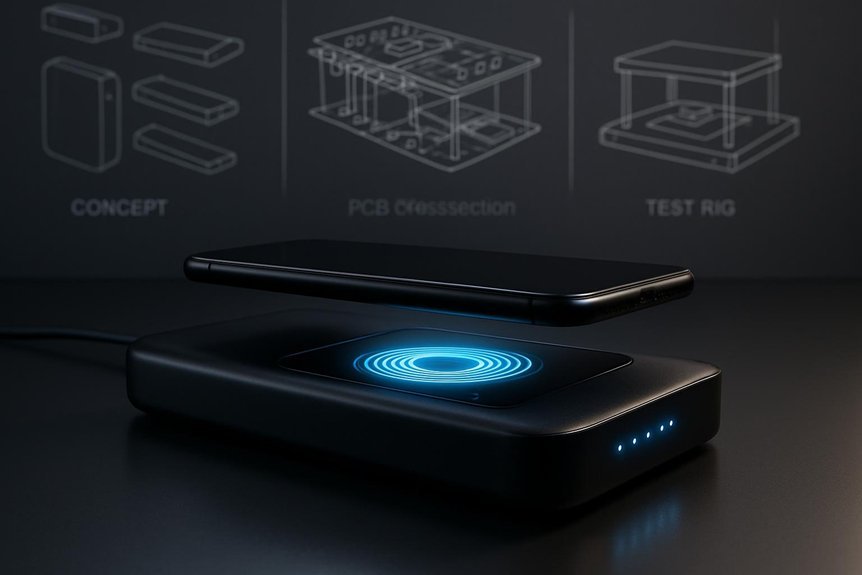
We start by defining the Wireless Charging Interface we’ll support across batteries and power banks, ensuring compatibility with common standards while preserving safety margins. Next, we set Coil Alignment Tolerance targets to accommodate user variability without compromising charging efficiency or thermal limits, and we specify verification tests for misalignment scenarios. Finally, we outline Power Management Strategies that balance input negotiation, heat dissipation, and battery health during top-ups, establishing a repeatable design trajectory.
Wireless Charging Interface
To enable seamless top-ups, we define a modular wireless charging interface that can be integrated into batteries and power banks with a focus on reliability and safety.
- Establish a standardized power profile to ensure consistent energy transfer
- Implement robust shielding to mitigate rogue interference and EMI
- Use a durable casing that protects internal routing and connectors
- Integrate fault-tolerant control logic with clear fault signaling
- Validate alignment windows and thermal behavior under duty cycles
We document interface boundaries, placement tolerances, and safety interlocks to prevent induced faults. By modularization, we enable plug-and-play compatibility across units, while preserving efficiency and low standby loss. Our approach emphasizes reproducibility, traceable testing, and clear documentation for integration teams.
Coil Alignment Tolerance
Coil alignment tolerance directly governs the efficiency and reliability of wireless top-ups, so we define precise positional and angular limits to ensure consistent energy transfer without overheating. We evaluate coil misalignment impacts by quantifying lateral, angular, and axial deviations relative to the pad geometry, establishing acceptable envelopes for each configuration. Our approach pairs a target coupling coefficient with a maximum hot-spot risk threshold, guiding a pragmatic tolerance budget. We specify reference plane alignments, edge clearances, and rotation bounds that preserve Q factor and stray field control. We document metrology steps for recurring assembly checks and alignments, plus procedure flags for out-of-tolerance events. Throughout, we emphasize pad geometry as the foundational determinant of tolerance, anchoring tests to repeatable benchmarks and serving as the basis for robust, repeatable top-ups.
Power Management Strategies
How can we architect the power management framework to enable reliable wireless top-ups for batteries and power banks? We design a structured workflow that balances efficiency, safety, and battery longevity. Our approach integrates sensing, control, and protection to sustain continuous operation during coil misalignment, temperature drift, and load variations.
- battery calibration routines to align capacity estimates with real performance
- thermal profiling to anticipate hotspot development and throttle charging
- adaptive power rails that adjust charging current by distance and alignment
- state-of-charge and health monitoring for accurate, timely shutdown or fallback
- fault-tolerant communication between receiver, transmitter, and battery management system
This framework minimizes idle losses, preserves cycle life, and ensures predictable top-up behavior under real-world conditions.
Efficiency, Heat, and Safety in Real-World Wireless Charging
Is wireless charging efficient enough in real devices to justify its use, or do heat and safety concerns undermine its practical benefits? We approach this by framing concrete metrics and constraints. We compare input-output efficiency across typical receivers, noting that efficiency tradeoffs emerge from coil coupling, alignment sensitivity, and compensation circuitry. We quantify losses from core resistance, skin effects, and shunt regulation, then discuss how thermal generation tracks load and distance. Our focus is on reliable operation, not ideal lab conditions, so we assess thermal margins under continuous and intermittent use. We describe thermal management strategies that preserve efficiency while limiting temperature rise, including airflow design, thermal vias, and duty cycling. Safety margins rely on insulation, overcurrent protection, and temperature thresholds to prevent degradation or hazards.
Practical Integration Patterns and Real-World Case Studies
Practical integration patterns reveal how wireless charging fits into real devices, not just lab setups. We document approaches that balance efficiency, form factor, and durability, sharing concrete patterns from field deployments. Our focus stays technical, actionable, and concise, with attention to battery lifespan and coil materials to sustain performance over time.
- Pattern: surface-masstaging pads with alignment guides for robust user interaction
- Pattern: integrated flex coils for curved surfaces without performance loss
- Pattern: shielded modules to minimize EMI and thermal hotspots
- Case study: rugged tools with ambient charging in harsh environments
- Case study: wearables emphasizing low-power strategies and long battery lifespan
In each example, material choices and layout decisions directly influence reliability, maintenance, and lifecycle costs.
How to Evaluate Vendors, Testing, and Deployment Paths
What criteria matter most when selecting vendors, conducting tests, and outlining deployment paths for wireless charging integrations? We approach vendor evaluation with structured due diligence: assess architecture compatibility, roadmaps, compliance, and support. We perform vendor due diligence by verifying financial stability, product maturity, and integration experience in portable power contexts. Our testing protocols are written, repeatable, and objective: define ingress/egress power ranges, thermal behavior, SAR/EMI considerations, efficiency, and alignment with safety standards. We validate firmware update processes, security posture, and interoperability with existing devices. For deployment paths, we map phased rollouts, risk mitigation, and rollback strategies, linking timelines to certification milestones and supply chain constraints. The outcome is a concise recommendation package detailing risk, cost, and schedule, enabling informed, confident procurement and seamless integration.
Frequently Asked Questions
How Do Wireless Chargers Impact Battery Warranty and Service Life?
We believe wireless chargers do not void battery warranty if used as intended; however, improper use or third-party accessories can affect service life. We assess heat, alignment, and power profiles to protect battery warranty and optimize service life.
Can Wireless Charging Work Reliably in Extreme Temperatures or Outdoors?
We can get reliable wireless charging outdoors, though extreme temperature can degrade efficiency and battery life; our tests show outdoor reliability improves with ruggedized insulation, thermal management, and environmental sealing implemented in design.
What Are the Hidden Costs of Integrating Wireless Charging Modules?
Hidden costs include iterative prototyping, EMI shielding, and regulatory testing. In a hypothetical case, we faced longer supply cycles for component sourcing. We’ll quantify upfront, document tradeoffs, and track Hidden costs to avoid surprises.
How Does Hand-Off Between Wired and Wireless Charging Affect Performance?
Handoff between wired and wireless charging affects performance through measurable handoff latency, with modest efficiency tradeoffs during transitions. We assess constant current behavior, monitor peak power, and optimize control loops to minimize latency while preserving overall device efficiency.
Are There Regulatory Labeling Requirements for Consumer Wireless Charging Devices?
We can confirm: yes, regulatory labeling exists for consumer wireless charging devices, and compliance testing is required before market release. We meticulously verify labels and test results, ensuring Regulatory labeling accuracy and Compliance testing pass before we ship to readers.
Conclusion
We’ve wired the future together, like a compass needle finally aligning with north. Symbolically, wireless charging is the quiet current that steadies our devices, guiding efficiency through coil, heat, and power management. As we test, certify, and deploy, we’re stitching standards into every battery, every pad, every module. The result is a resilient ecosystem: predictable performance, safer operation, and scalable rollout that marches with clarity. Trust the signal: simple, reliable, and ever-present.