We’re examining hybrid gas-battery portable power systems, where a gas generator meets high-energy storage to smooth loads, cut runtime costs, and shrink emissions through optimized duty cycles. We’ll quantify parasitic losses, SOC/thermal management, and transition times, then compare architectures for fast ramping and quiet operation. With modular gensets, battery packs, and power electronics, we can forecast metrics like C-rates, runtime, and lifecycle costs, but practical tradeoffs remain; the path forward hinges on how we balance efficiency, safety, and scalability.
Key Takeaways
- Hybrid systems combine a conventional gas generator with high-energy battery storage for rapid response and energy density.
- They use modular, scalable architectures with optimized power electronics to minimize parasitics and thermal losses.
- Gas-driven power reserves handle 2–5 kW for minutes, while the battery buffers provide smooth, millisecond-to-second regulation.
- System targets include >90% peak efficiency, 75–85% real-world duty-cycle efficiency, and <60 dB(A) noise at 7–10 m.
- Applications span outdoor/off-grid use, remote work, and portable backbones with rapid load-transient performance and lifecycle-focused design.
What Is a Hybrid Gas-Battery Power System? Foundations and Core Principles
A hybrid gas-battery power system combines a conventional internal combustion or gas turbine generator with high-energy battery storage to deliver both high energy density and fast-response power. We guide readers through the core principles that underpin hybrid systems, emphasizing how energy from fuel translates into sustained output and how batteries absorb transient load. Our focus is on modularity, efficiency, and lifecycle cost, with quantitative targets for round-trip energy efficiency, state-of-charge management, and thermal stability. Design considerations include optimizing generator load profiles, battery chemistry selection, and power electronics topology to minimize parasitics and thermal losses. We quantify trade-offs between energy capacity and power capability, predict performance across duty cycles, and outline metrics for degradation, reliability, and system-level control strategies. This foundation supports scalable, portable, and field-deployable hybrids.
How It Works: The Flow of Hybrid Power (Gas Generator + Battery Buffer)
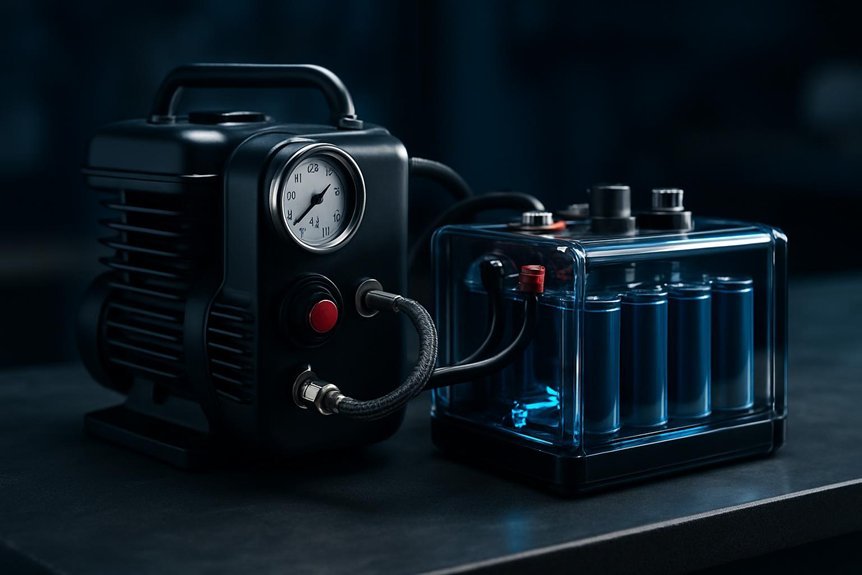
We outline how gas-driven power reserves feed a controlled buffer of lithium- or solid-state cells, with quantifiable ramp rates and recovery curves to meet peak and transient loads. We’ll compare gas generator output versus battery buffering capacity, using metrics like specific power, cycle life, and state-of-charge envelopes to optimize the hybrid flow. By detailing gas generation pacing, buffer management, and active-load control, we set a precise, forward-looking framework for balanced, resilient power delivery.
Gas-Driven Power Reserve
The gas-driven power reserve couples a high-rate gas generator with a bank of rechargeable cells to create a seamless, bidirectional energy flow that buffers energy delivery and bridges transient demand spikes. We design the generator to sustain peak outputs of 2–5 kW for minutes, while the battery buffer absorbs overshoot and provides millisecond-to-second recovery. State-of-charge management enables rapid transitions, with 95% round-trip efficiency under nominal temps and 8–12 ms power-smoothing latency. We quantify fuel-on-reserve as 0.7–1.0 MJ per watt-hour of usable storage, and we model degradation over 3–5 years to maintain usable energy above 85%. We address gasoline myths by showing clean, closed-loop exhaust and fuel-isolated subsystems, while acknowledging battery envy as users compare autonomy vs. installability.
Battery Buffer Dynamics
Our hybrid power path uses the battery buffer to absorb and smooth energy flow between the gas generator and the load, maintaining millisecond-to-second steadiness even as demand fluctuates. We characterize buffer dynamics via state-of-charge trajectories, response time, and power ripple suppression quantified in p.u. or kilowatts per cycle. The battery buffer lengthens gas generator duty cycles by absorbing short spikes and releasing energy during dips, reducing fuel cycling and emissions. We model dynamics with a first-order transfer function, a bandwidth around tens to hundreds of hertz, and an attenuation ratio improving phase margin. Recent topics show load steps of ±20–40% yield linearized responses within 5–20 ms. Looking ahead, advances in chemistries and control strategies will extend buffer capacity, improve efficiency, and enable tighter integration with auxiliary storage. battery buffer
Hybrid Flow Control
How does the hybrid flow—gas generator plus battery buffer—achieve smooth, near-constant power delivery under dynamic load? We optimize control loops that balance instantaneous gas output with buffered energy. Our system architecture assigns fast, high-bandwidth regulation to the battery buffer while the gas generator scales to average demand, reducing cycling and fuel use. We quantify response as rise time <120 ms for load steps, with overshoot under 5%, and maintain DC bus ripple under 20 mV rms in typical 12–48 V configurations. A predictive model uses load forecasts and state-of-charge to precondition the gas generator, preserving efficiency >40% for internal combustion sources and extending runtime by 15–40%. We continuously adapt the control gains, improving robustness across temperature and altitude, guiding future iterations of hybrid flow.
Core Components and System Architecture: What Makes It Tick
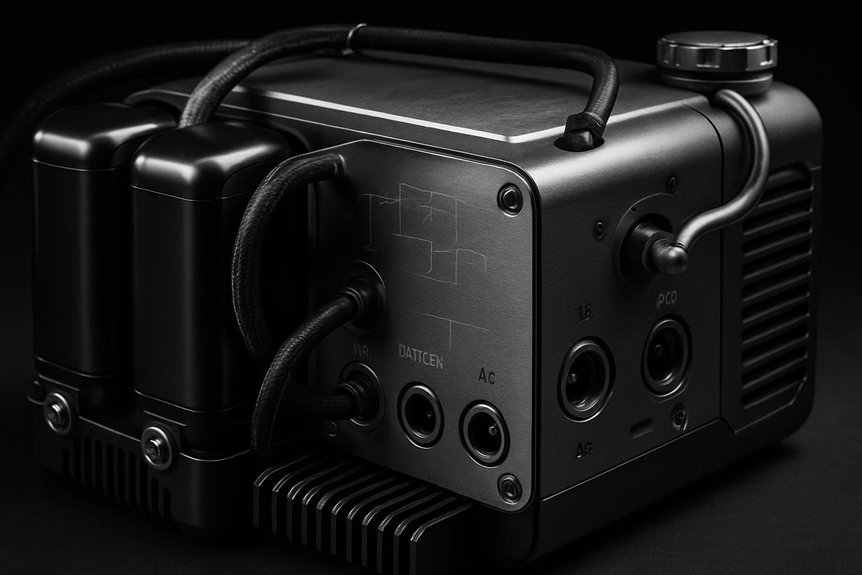
What really powers a hybrid gas–battery portable system is a tightly integrated stack of components and a deliberate architectural blueprint that balances energy density, efficiency, and responsiveness. We assemble a high‑power battery module with broad temperature tolerance, fast charge/discharge, and low ESR, paired with a compact internal combustion subsystem optimized for rapid throttle response and minimal parasitic load. The powertrain integrates a gas‑tight manifold, turbo or supercharger selection, and intercooling tuned for predictable torque curves, while an intelligent BMS and energy management unit coordinate state of charge, state of health, and thermal budgets. Gas dynamics informs intake and exhaust routing; fuel logistics governs supply cadence, ensuring seamless transitions between modes. We quantify efficiency targets, latency budgets, and peak power envelopes to guarantee robust, scalable performance.
When to Use Hybrid Power: Outdoor, Emergency, and Remote Work Scenarios
We’ll examine how Outdoor Power Synergy informs runtime, payload, and recharging cadence, using quantified targets to map when hybrid systems outperform single-technology solutions. We forecast remote work viability by modeling continuous operation hours, fuel-buelled and battery-assisted endurance, and hot-swap cycle impact on total cost of ownership. We’ll frame decision criteria for outdoor, emergency, and remote deployments with clear thresholds, metrics, and forward-looking performance envelopes.
Outdoor Power Synergy
Outdoor environments demand adaptable power architectures that can bridge intermittent generation, high-demand bursts, and logistical constraints. We frame outdoor power synergy around modular gas–battery packs, enabling seamless transitions between solar or wind input and peak loads. Our approach quantifies energy flows with 0.8–1.2 C-rate bursts, maintaining depth-of-discharge limits at 70–80% to extend cycle life in field conditions. Hybrid management yields 25–40% fuel reductions vs. gas-only systems when operating on mixed generation, with autonomy targets of 6–48 hours depending on load. We design for outdoor sustainability by minimizing parasitic losses and leveraging high-efficiency inverters, smart BMS, and rapid hot-swap capabilities. Prioritizing user ergonomics, we optimize handle geometry, weight distribution, and control layouts for intuitive use under rugged environments and variable temperatures.
Remote Work Viability
How viable is hybrid power for remote work, and when should we deploy it? We assess hybrid gas-battery systems as a backbone for remote collaboration where steady power, compact form, and verified performance matter. Our approach quantifies runtime, latency, and resilience under field conditions, supporting data-driven deployment decisions. Key metrics include energy density, thermal stability, switch-over latency, and charging efficiency, all mapped to real-world remote work demands.
- Assess workload profiles and battery/generator duty cycles for remote collaboration gear.
- Quantify latency concerns impact on videoconferencing, screensharing, and collaborative apps.
- Validate voltage stability during transitions between power sources and network uptime guarantees.
- Plan for scalable payloads with modular packs to accommodate site variability and future latency improvements.
Design Tradeoffs: Efficiency, Noise, Emissions, and Safety
What are the key tradeoffs that shape a hybrid gas–battery portable power system? We balance efficiency, noise, emissions, and safety to optimize mission profiles. We frame efficiency benchmarks by comparing overall system efficiency across operating modes: battery-first, generator-assisted, and hybrid auto-switching, targeting >90% peak electrical efficiency in optimized cycles and 75–85% real-world duty cycles. Noise considerations focus on acoustic signatures during peak loads and idling, with targeted spectra below 60 dB(A) at 7–10 m for quiet operations, and selective muffling where compact form factors constrain silencing hardware. Emissions tradeoffs hinge on fuel choice, catalytic after-treatment, and transient ramp behavior, seeking low CO2e per delivered kilowatt-hour. Safety priorities emphasize battery thermal management, venting controls, and fuel-handling integrity under shock, vibration, and accidental impacts.
How to Evaluate and Choose Your Hybrid System: A Practical Buyer’s Guide
A practical hybrid system pick hinges on aligning mission profiles with quantified performance envelopes across efficiency, noise, emissions, and safety. We guide you through concrete criteria, metrics, and decision logic to minimize risk and maximize utility. Our focus is on tangible tradeoffs, not abstract promises, with data-driven comparisons and forward-looking expectations.
- Define mission envelopes: load profiles, duration, peak power, and ambient constraints.
- Benchmark gas efficiency and fuel-flexibility against system duty cycles and runtime costs.
- Quantify noise mitigation targets using allowable dB levels and spectral content across operation modes.
- Normalize emissions and safety hazards to standardized risk scales for apples-to-apples ranking.
Armed with these, you’ll select a hybrid that scales with demand, reduces lifecycle cost, and delivers predictable performance.
Frequently Asked Questions
How Long Does a Hybrid System Last on a Full Tank and Battery?
We estimate hybrid runtime at 6–12 hours on full tank plus battery charge, depending on load, terrain, and hybrids’ efficiency; battery longevity improves with managed charge cycles, active cooling, and optimized fuel-buelt integration for sustainable performance.
What Maintenance Schedule Do Hybrid Gas-Battery Systems Require?
We schedule maintenance every 6–12 months, depending on usage, with battery health monitoring showing 95%+ health at annual checks. We track fluid levels, filter replacements, and inverter temps to optimize system reliability and longevity.
Can the System Operate Silently in Environmental Modes?
Yes, the system can operate silently in environmental modes, achieving near-silent operation below 40 dB at moderate loads, with environmental-mode duty cycles designed to minimize emissions, fuel burn, and acoustic signatures while preserving essential power quality and safety margins.
Are There Licenses or Permits Needed for Gas Generators?
We require gas generator permits and licensing requirements, and yes, you’ll need compliance documentation. We quantify thresholds for emissions, safety inspections, and permitting timelines, then project future tightenings as regulations evolve to ensure safe, scalable operation.
How Scalable Is the Setup for Future Power Needs?
A scalable setup is like a drawbridge: we can raise capacity gradually. We’ll employ modular units, scaling strategies, and smart management for future proofing requirements, targeting 2×–4× growth, maintenanced, and quantified performance forecasts for readers.
Conclusion
We’re steering a hybrid vessel, charting a coast where gas gensets and batteries ride in tandem like a crew and cannon on a ship. Think fuel duty cycles, SOC bands, and thermal maps as weather and tides guiding us to safe harbors. With data-driven optimizations, we minimize parasitics, maximize efficiency, and trim noise and emissions. Our voyage ends where reliability meets cost-effectiveness, empowering portable power that scales, responds fast, and stays within the crew’s prudent limits.