We’re putting the FOSSIBOT F2400 through a practical test of capacity, output, charging speed, and field durability. Its 2048Wh LiFePO4 battery and 2400W inverter suggest serious capability for home backup, camping, and RV use, while the 22kg frame demands some planning. We’ll examine its ports, safety systems, waterproof construction, and everyday limitations to see whether its rugged design delivers dependable power when conditions turn difficult.
Key Takeaways
- The FOSSIBOT F2400 delivers 2,400W continuous output and 4,800W surge capacity for refrigerators, power tools, and essential appliances.
- Its 2,048Wh LiFePO4 battery provides over 4,000 cycles, balancing long service life, safety, and reliable backup performance.
- AC charging reaches 80% in approximately 1.5 hours, while solar and vehicle charging provide flexible off-grid options.
- Rugged waterproof construction, multiple ports, sturdy handles, and comprehensive BMS protections support demanding outdoor and emergency use.
- At 22kg, it is heavy and bulky; separate solar panels, slow car charging, and high replacement costs are notable drawbacks.
2048Wh LiFePO4 Capacity
The FOSSIBOT F2400’s 2048Wh LiFePO4 battery provides substantial energy storage for home backup, camping, RV travel, and off-grid work. We can run essential appliances, lighting, communications gear, and tools without constantly rationing power.
Its lithium iron phosphate chemistry supports strong Battery longevity, delivering over 4,000 full cycles and nearly a decade of practical service. That durability suits demanding field use and repeated emergency deployment.
Charging efficiency also matters: we can restore up to 80% capacity from AC in about 1.5 hours, while solar and vehicle inputs extend independence away from the grid. This capacity balances endurance, safety, and rugged reliability.
Detailed features
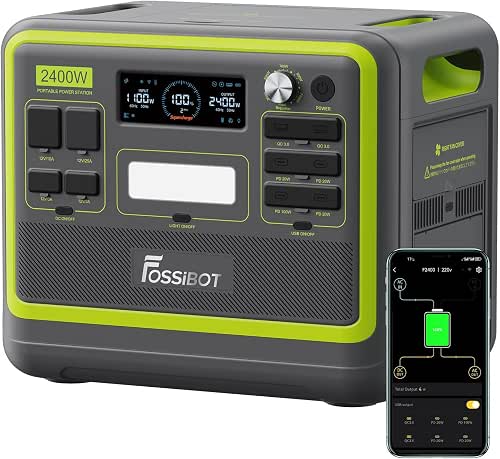
Beyond its 2048Wh capacity, the FOSSIBOT F2400 combines rugged construction, flexible outputs, and intelligent protection for dependable field use. Its waterproof silicone exterior, military-grade ABS housing, brass components, and sturdy handles withstand demanding transport and campsite conditions.
We get three 2400W AC sockets, USB-A, fast USB-C, DC, XT-60, and vehicle outlets for running tools, appliances, communications gear, and lights simultaneously.
Bidirectional charging supports AC, solar, and vehicle inputs.
The LiFePO4 pack delivers a long Battery lifespan exceeding 4,000 cycles.
All-encompassing Safety features include BMS protection against overcharge, over-discharge, overload, short circuits, over-temperature, and voltage faults.

Pros and Cons
We’ll weigh the F2400’s rugged build, LiFePO4 longevity, high output, and flexible charging against its 22 kg bulk and separately sold solar panels.
You’ll see how its broad port selection and strong safety systems perform in practical backup and off-grid use.
We’ll also flag the limits that may affect transport, charging time, and overall value.
Pros
Because it combines a 2048Wh LiFePO4 battery with 2400W continuous output and 4800W surge capacity, the FOSSIBOT F2400 can handle demanding loads such as refrigerators, power tools, kitchen appliances, and communication equipment.
We get dependable Battery longevity from more than 4,000 charge cycles, while the LiFePO4 chemistry and protective BMS support safer operation.
Its rugged silicone exterior, military-grade ABS, and brass components suit harsh handling and field use.
Outdoor versatility is another strength: we can run camping equipment, RV accessories, lighting, and radios from varied ports.
Fast AC charging, solar compatibility, emergency lighting, and a five-year warranty further improve practical readiness.
Cons
Although the FOSSIBOT F2400 offers substantial capacity, its 22kg weight and bulky 386 × 284 × 321mm chassis limit portability compared with smaller power stations. These portability challenges become obvious on steep trails, in tight vehicle storage, or when we carry it without assistance.
The optional trailer improves mobility, but adds equipment and setup requirements. Solar charging also demands separately purchased panels and suitable weather, while car charging takes roughly 17 hours.
Although LiFePO4 chemistry supports impressive battery longevity, replacement costs may remain significant after years of service. We should also allow ventilation around the inverter during sustained high-load operation to manage heat effectively.
Concluding thoughts
After testing its capacity, output flexibility, and charging options, we found the FOSSIBOT F2400 to be a rugged, practical backup for home emergencies, camping, RV travel, and off-grid work.
Its 2048Wh LiFePO4 battery, 2400W continuous output, and broad port selection handle demanding loads without sacrificing control.
Battery longevity stands out, with more than 4,000 cycles supported by an all-encompassing BMS.
We also appreciate its portable convenience: sturdy handles, weather-resistant construction, and useful lighting improve field usability.
Although its 22kg weight limits casual carrying, the F2400 rewards planned transport with dependable power, fast AC charging, and durable performance when infrastructure fails.
Frequently Asked Questions
How Long Does the FOSSIBOT F2400 Take to Recharge Using a Wall Outlet?
We can recharge the FOSSIBOT F2400 from a wall outlet to 80% in about 1.5 hours. Its 2048Wh Battery capacity and rapid AC Charging time keep us ready for demanding backup or outdoor use.
Can the F2400 Be Used as an Uninterrupted Power Supply During Outages?
Yes, we can use the F2400 as a UPS during outages, maintaining connected equipment through its 2,048Wh battery capacity. Its portability features support rugged deployment, while protection systems help safeguard devices during interruptions.
Is a Solar Panel Included With the FOSSIBOT F2400?
No, we don’t receive a solar panel with the F2400. We get solar panel compatibility, supporting a separate 500W panel, creating rugged, portable solar solutions for off-grid charging, emergencies, camping, and remote work.
How Portable Is the F2400 for Camping, Travel, or Emergency Transport?
We can transport the 22kg F2400 using its comfortable handles, while a small trailer improves mobility. Its rugged, waterproof-silicone and military-grade ABS construction suits camping, travel, and emergency transport, though Battery capacity limits lightweight portability.
What Warranty and Customer Support Does FOSSIBOT Provide?
We get a five-year warranty covering the F2400, plus lifetime customer support. Warranty coverage supports long-term rugged use, while Customer service quality helps us resolve technical issues throughout the station’s service life.
Conclusion
We found the FOSSIBOT F2400 ready for serious backup, demanding worksites, and extended adventures. Its 2048Wh LiFePO4 battery delivers dependable runtime, its 2400W inverter handles heavy loads, and its rugged, water-resistant housing stands up to rough conditions. It isn’t light, but it is built to move power, protect equipment, and keep essential systems running. For home emergencies, campsites, and RVs, we’d choose the F2400 when durability, capacity, and practical performance matter most.