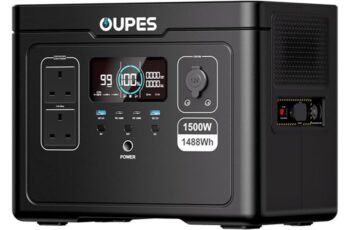
We’re examining the Anker SOLIX C1000 Gen 2 as a portable power station for backup, travel, and off-grid use. Its 1,024Wh LiFePO4 battery, 2,000W continuous output, 3,000W peak capacity, and 10ms UPS response provide a capable foundation, while HyperFlash charging reaches full capacity in about 49 minutes. We’ll also weigh its solar support, app controls, portability, runtime limits, and whether its 11.3kg design suits your priorities.
Key Takeaways
- The Anker SOLIX C1000 Gen 2 delivers 2,000W continuously and 3,000W peak, powering up to nine devices simultaneously.
- Its 1,024Wh LiFePO4 battery recharges from AC in approximately 49 minutes using 1,600W HyperFlash charging.
- Solar charging supports up to 600W input, potentially fully recharging the station in about 1.8 hours under ideal sunlight.
- A 10ms UPS protects sensitive electronics, while over 4,000 cycles support more than a decade of battery use.
- Compact and app-managed, it weighs 11.3kg; limitations include short maximum-load runtime, possible fan noise, and solar dependence.
49-Minute HyperFlash Charging
How quickly can it recharge? We can restore the Anker SOLIX C1000 Gen 2’s 1,024Wh battery from AC power in approximately 49 minutes using HyperFlash technology and its upgraded 1,600W charging rate. This charging speed reduces downtime between uses and supports practical emergency or daily-power routines.
The system also accepts up to 600W of solar input, reaching a full charge in roughly 1.8 hours under suitable conditions.
We should distinguish recharge performance from battery longevity: the LiFePO4 battery is rated for more than 4,000 cycles, retaining at least 80% capacity afterward. That supports dependable operation over an estimated decade.
Detailed features
Beyond its 49-minute AC recharge, the Anker SOLIX C1000 Gen 2 combines a 1,024Wh LiFePO4 battery with a 2,000W continuous output and 3,000W peak capacity, allowing us to run up to nine devices through its available outlets.
Its 600W solar input supports off-grid charging in approximately 1.8 hours, while a 10ms UPS helps maintain power for laptops and CPAP machines.
We can monitor output, schedule charging, and manage settings through the Anker app.
The Portable design measures 38.4 × 20.8 × 24.4cm and weighs 11.3kg.
Battery longevity reaches over 4,000 cycles, retaining at least 80% capacity.
Pros and Cons
We’ll weigh the SOLIX C1000 Gen 2’s compact design, high output, rapid charging, durable LiFePO4 battery, and UPS functionality against its limitations.
We’ll also consider its 1,024Wh capacity, full-load runtime, weight, and solar-charging requirements.
This comparison will clarify whether its performance and support justify its cost for home backup, travel, and emergency use.
Pros
The Anker SOLIX C1000 Gen 2’s main advantages are its compact design, high output, rapid charging, and durable LiFePO4 battery. We can power up to nine devices with 2,000W continuous output and 3,000W peak capacity, while HyperFlash restores AC power in 49 minutes. Its Portability features include an 11.3-kilogram body and 14% smaller footprint than comparable units. Battery durability is equally strong, with over 4,000 cycles and at least 80% capacity retention.
| Advantage | Specification | Benefit |
|---|---|---|
| Output | 2,000W / 3,000W peak | Runs demanding equipment |
| Charging | 49 minutes AC | Minimizes downtime |
We also get solar input and a five-year warranty.
Cons
Despite its strong performance, the Anker SOLIX C1000 Gen 2 has several limitations. We get only about 30 minutes of runtime at the 2,000W maximum, so high-demand appliances quickly exhaust its 1,024Wh capacity.
Its 11.3-kilogram weight remains substantial for frequent carrying, despite the compact design.
We should also consider Battery degradation: although Anker rates the LiFePO4 pack for more than 4,000 cycles and 80% capacity retention, real-world temperature, load, and charging habits can reduce longevity.
Noise levels may increase during high-power output or rapid HyperFlash charging, potentially disturbing quiet rooms.
Solar charging also requires suitable sunlight and compatible installation.
Concluding thoughts
Overall, we find the Anker SOLIX C1000 Gen 2 to be a well-balanced portable power station for home backup, travel, and off-grid use. Its 1,024Wh capacity, 2,000W output, 49-minute AC recharge, and 600W solar input provide practical flexibility.
While the 10ms UPS supports sensitive equipment during outages, we also value its LiFePO4 durability, five-year warranty, and compact 11.3kg design.
Battery efficiency depends on load, temperature, and conversion losses, so real-world runtimes won’t match capacity ratings exactly. Still, the app, scheduling controls, and broad outlet selection strengthen the user experience.
We recommend it for buyers prioritizing speed, longevity, and dependable versatility.
Frequently Asked Questions
What Accessories Are Included With the Anker SOLIX C1000 Gen 2?
We’ll find the SOLIX C1000 Gen 2 packaged with an AC charging cable, quick-start guide, safety card, and warranty documentation. Its solar compatibility and portability features require no additional included accessories.
How Much Does the Anker SOLIX C1000 Gen 2 Weigh?
Weighing approximately 11.3 kilograms, we can see how its portable design balances manageable transport with a substantial battery capacity. You’ll find this weight practical for emergency backup, camping, and flexible off-grid power deployment.
What Warranty Does Anker Provide for This Power Station?
Anker provides a five-year warranty for this power station, covering eligible defects and hardware issues. We can also use customer support and a 30-day return period for additional warranty coverage assistance.
How Many Devices Can the SOLIX C1000 Gen 2 Power Simultaneously?
We can power up to nine devices simultaneously, supported by a 2,000W maximum output. Its 1,024Wh battery capacity and port versatility let you run laptops, appliances, and essential equipment together reliably.
Can the Anker SOLIX C1000 Gen 2 Be Controlled Remotely Through an App?
Yes, we can use the Anker app for remote app control through mobile connectivity. We’ll monitor output, manage settings, schedule charging, and optimize energy consumption remotely, helping us avoid peak electricity surcharges during operation.
Conclusion
We find the Anker SOLIX C1000 Gen 2 a compelling middle ground: its 49-minute HyperFlash recharge, 2,000W output, LiFePO4 longevity, and 10ms UPS make it unusually practical. It won’t, however, power a household indefinitely—despite what survivalist marketing might imply—and its 11.3kg frame won’t vanish into a backpack. For backup, travel, and off-grid work, we think its versatile performance outweighs those limits, provided we match expectations to its finite capacity and full-load runtime.