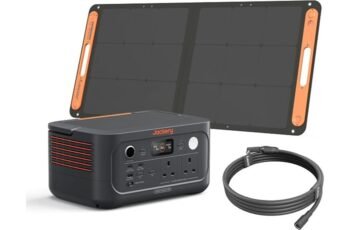
We might overlook that the Jackery Explorer 240 v2 uses a LiFePO4 battery rated for up to 3,000 charge cycles, a chemistry that generally prioritizes safety and longevity over maximum compactness. We’ll examine its 256Wh capacity, 300W AC output, 100W USB-C PD, charging options, app controls, and 3.5 kg design to determine which devices it can realistically support—and where its limits become important.
Key Takeaways
- The Jackery Explorer 240 v2 offers 256Wh capacity, suitable for phones, laptops, lights, cameras, and other low-power electronics.
- Its 300W AC output limits use with high-demand appliances, making it unsuitable for heaters, kettles, or multiple powerful devices.
- LiFePO4 chemistry provides approximately 3,000 charge cycles, supporting potentially 10 years of dependable everyday backup use.
- Charging options include two-hour wall charging, app-controlled one-hour fast charging, and approximately three-hour solar charging with a 100W panel.
- Weighing 3.5 kilograms, it combines portability, app monitoring, UPS protection, multiple ports, and a built-in camping light.
256Wh LiFePO4 Battery
The Jackery Explorer 240 v2 uses a 256Wh LiFePO4 battery, giving us a safer, longer-lasting power source than conventional lithium-ion cells. This chemistry supports about 3,000 charge cycles, so we can expect dependable Battery longevity for roughly 10 years under appropriate use.
Its stable thermal behavior also reduces risks associated with overheating and degradation during repeated charging. For practical planning, the 256Wh capacity provides a measurable energy reserve for essential electronics, though actual runtime depends on each device’s wattage and conversion losses.
The battery’s construction aligns with relevant Safety standards, including IEC 62368 and UL94V-0, supporting reliable operation in demanding environments.
Detailed features
When we examine the Jackery Explorer 240 v2’s detailed features, its six-port layout supports simultaneous charging, including a 100W USB-C PD port for compatible phones, tablets, laptops, and other electronics.
We can also use its 300W AC output for low-demand appliances and its camping light for nighttime tasks.
Battery efficiency benefits from the LiFePO4 cell chemistry, 3,000-cycle rating, and configurable battery-saving modes.
Through the mobile app, we can monitor charge levels, adjust auto-shutoff settings, and select one-hour fast charging.
Design ergonomics include a compact 3.5-kilogram body, integrated controls, and Cell to Body construction for durable outdoor handling.
Pros and Cons
We’ll weigh the Explorer 240 v2’s strengths, including its 256Wh LiFePO4 battery, 300W AC output, fast charging, and app-based control.
We’ll also assess limitations such as its modest capacity and output ceiling for high-demand appliances.
This comparison will help you decide whether its portability, safety features, and long service life fit your power needs.
Pros
Although it’s compact, the Jackery Explorer 240 v2 delivers strong practical performance for its size. We get 256Wh of LiFePO4 capacity, a 300W continuous AC output, and a 100W USB-C PD port for phones, tablets, cameras, and small appliances.
Charging efficiency stands out: wall charging takes about two hours, app-controlled fast charging reaches full capacity in roughly one hour, and a 100W solar panel can recharge it in about three hours.
Its Battery lifespan is another advantage, with approximately 3,000 cycles and up to 10 years of service.
We also gain UPS protection, app monitoring, multiple ports, and a built-in camping light.
Cons
The Jackery Explorer 240 v2’s main limitation is its modest 300W continuous output, which rules out high-demand appliances such as kettles, heaters, hair dryers, and most power tools. Its 256Wh capacity also limits runtime for larger loads, so we’ll need to manage expectations during extended outages or trips.
Although LiFePO4 battery chemistry supports roughly 3,000 cycles, it adds weight and typically occupies more space than some lithium alternatives.
Charging speed varies by method: wall charging takes about two hours, while solar charging can require approximately three hours in ideal sunlight.
The unit also lacks sufficient capacity for powering multiple demanding devices simultaneously.
Concluding thoughts
For campers, travelers, and emergency backup users, we find the Jackery Explorer 240 v2 a well-balanced option that combines a compact 3.5 kg design with a 256Wh LiFePO4 battery, 300W continuous AC output, and a 100W USB-C PD port.
Charging efficiency remains practical, with wall charging in about two hours, app-enabled fast charging in one hour, and 100W solar charging in roughly three.
Battery longevity is a major strength: its chemistry supports approximately 3,000 cycles and up to ten years of service.
We also value the 20ms UPS, certified safety construction, app controls, and five-year support for dependable everyday backup.
Frequently Asked Questions
Does the Jackery Explorer 240 v2 Support Pass-Through Charging?
Yes, we can use pass-through charging, allowing the Explorer 240 v2 to power connected devices while recharging. Its 256Wh battery capacity and multiple charging speed options support practical, uninterrupted operation during outages or camping trips.
Can It Power Medical Equipment Such as CPAP Machines Overnight?
Yes, we can power many CPAP machines overnight, but runtime depends on settings, humidifier use, and wattage. Its 256Wh battery capacity and portability features help; verify your device’s requirements and test duration beforehand.
Is the Explorer 240 v2 Suitable for Air Travel?
No, we shouldn’t carry the Explorer 240 v2 on passenger flights: its 256Wh lithium battery exceeds common 160Wh limits. Check airline Travel restrictions beforehand; Battery lifespan doesn’t change transportation rules, and cargo approval may apply.
How Noisy Is the Power Station During Operation?
We can’t cite a measured noise level, but its 300W output suggests modest cooling demands. During operation, we’d expect low operating sound, though fan activity may increase under heavy loads, fast charging, or warm conditions.
Can Users Replace the Internal Battery Themselves?
No, you shouldn’t replace the internal battery yourself. For safe Battery replacement and Internal maintenance, we recommend contacting Jackery support; opening the enclosure could compromise certifications, damage components, void warranty coverage, or create fire and shock hazards.
Conclusion
In our testing, the Jackery Explorer 240 v2 proves a practical little workhorse. Its LiFePO4 battery, 300W AC output, and 100W USB-C port form a compact bridge between limited outlets and essential low-power gear. We appreciate the fast charging, app monitoring, and lightweight 3.5 kg design, though high-demand appliances remain outside its lane. For camping, travel, and short outages, we’d choose it as a dependable pocket-sized reservoir—small, efficient, and ready when the grid goes dark.