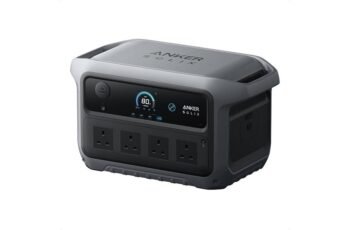
When the grid goes dark, the EF ECOFLOW DELTA Pro 3 can keep essential devices humming like a compact backup utility. We’ll examine its 4096Wh LFP battery, roughly 4,000-cycle lifespan, 4,000W output, and scalable charging system through a sustainability-focused lens. Its IP65 protection and rapid transfer support resilience, while its 51.5 kg weight and premium cost complicate mobility and access. The key question is whether its durability justifies those trade-offs.
Key Takeaways
- The EcoFlow DELTA Pro 3 offers a substantial 4,096Wh LFP battery designed for durability, safety, and approximately 4,000 cycles to 80% capacity.
- Its 4,000W continuous output, expandable to 6,000W with X-Boost, supports demanding appliances and sensitive electronics.
- Six charging methods, including AC, solar, generators, and EV stations, provide flexible power replenishment for varied situations.
- Expansion up to 12kWh makes it suitable for homes, off-grid setups, RVs, emergencies, and extended remote work.
- At 51.5kg, its excellent capacity and durability come with significant portability challenges and a premium overall cost.
4096Wh LFP Battery
The DELTA Pro 3’s 4096Wh lithium iron phosphate (LFP) battery balances substantial energy storage with long-term durability. We get a chemistry known for thermal stability, lower fire risk, and strong retention across repeated cycles.
Its approximately 4,000-cycle rating to 80% capacity gives us a measurable Battery lifespan approaching 11 years under regular use. That longevity can reduce replacement frequency, material consumption, and the Environmental impact associated with manufacturing and disposal.
We should still manage charging, temperature, and storage conditions carefully to preserve capacity. Overall, this battery supports dependable energy availability while aligning practical resilience with more sustainable long-term ownership for households and mobile users.


Detailed features
Beyond its durable 4096Wh LFP battery, we get a feature set designed for flexible, efficient power management. Battery durability benefits from automotive-grade cells, an integrated BMS, and an IP65-rated Cell-to-Chassis structure.
We can deliver 4000W continuously, or 6000W through X-Boost, while a 10-millisecond transfer supports sensitive electronics during outages.
Power versatility extends across six charging methods, including AC, solar, generators, and EV stations, reducing dependence on fossil-fuel inputs.
We can expand storage to 12kWh with extra batteries or Smart Generators.
At 51.5 kilograms, its compact 40-centimeter cube balances substantial capacity with practical deployment for homes, RVs, and remote sites.
Pros and Cons
We’ll weigh the DELTA Pro 3’s durable LFP chemistry, expandable capacity, and low-emission charging options against its 51.5 kg weight and substantial cost.
We’ll also assess its 4,000W output, rapid switchover, and long service life as benefits for resilient backup power.
Finally, we’ll consider whether its size, charging requirements, and accessory dependence limit practical sustainability and portability.
Pros
Although its 51.5-kilogram weight limits portability, the DELTA Pro 3 delivers substantial advantages: a durable 4,096Wh LFP battery, 4,000W continuous output, and 6,000W X-Boost capacity can run most household appliances without fossil-fuel dependence.
Its Battery lifespan reaches approximately 4,000 cycles before retaining 80% capacity, supporting nearly 11 years of regular use.
We value the integrated battery-management system, which regulates voltage, current, and temperature for safer, more consistent operation.
The generous Power capacity expands to 12kWh with extra batteries or Smart Generators.
Solar, AC, EV, and generator charging options also let’s tailor replenishment to available low-carbon energy sources.
Cons
The DELTA Pro 3’s main drawbacks are its 51.5-kilogram weight and 40-centimeter cube-like footprint, which make it difficult for one person to move despite its wheels. That mass also complicates transport for camping or emergency deployment, potentially increasing vehicle and handling requirements.
Its 4,096Wh battery can exceed typical daily needs, so unused capacity may reduce overall Battery efficiency when users recharge frequently without substantial loads. We’ll need careful Power optimization to prevent standby losses and maximize renewable charging benefits.
Although expandable storage improves resilience, extra batteries increase cost, embodied materials, and weight.
Finally, its premium price may limit accessibility for sustainability-focused households.
Concluding thoughts
For readers seeking dependable off-grid or emergency power, we find the EF ECOFLOW DELTA Pro 3 a capable and durable investment. Its 4,096Wh LFP battery, rapid transfer, and expandable architecture balance resilience with practical energy management. Battery lifespan benefits from automotive-grade cells and a 4,000-cycle rating, reducing replacement waste. Power versatility spans solar, AC, generators, EV charging, and demanding appliances.
| Strength | Practical value |
|---|---|
| LFP durability | Lower lifecycle waste |
| 4,000W output | Supports essential loads |
| Expandability | Adapts to demand |
| Six charging methods | Improves energy flexibility |
We’d choose it for sustained backup, remote work, or RV use, accepting its 51.5kg weight and premium cost as trade-offs for dependable, cleaner electricity.
Frequently Asked Questions
How Long Is the EF ECOFLOW DELTA Pro 3 Warranty?
We get a five-year warranty, giving us long-term coverage for this power station. Its Battery capacity and Port flexibility support sustainable backup, while customer support helps us resolve issues throughout ownership.
What Devices Are Included With the DELTA Pro 3 Purchase?
We don’t have a complete in-box device list, but we receive the DELTA Pro 3 power station, integrated battery, and charging accessories. Device compatibility spans appliances, servers, and electronics; Battery capacity reaches 4096Wh.
Where Can Customers Buy the EF ECOFLOW DELTA Pro 3?
We can buy the EF ECOFLOW DELTA Pro 3 through authorized online and offline retailers. We recommend checking availability, pricing, warranty coverage, and shipping before purchasing this sustainable Portable power system with expandable Battery capacity.
How Does Customer Support Handle Warranty Claims?
Customer service handles warranty claims through support channels, guiding us through the warranty process, troubleshooting, and documentation. We’ll receive assistance for covered defects under the five-year warranty, supporting sustainable repairs instead of unnecessary replacement.
Is Professional Installation Required for Home Backup Use?
Professional installation isn’t strictly required for basic home backup, but we recommend qualified help for hardwired connections. Consider Installation complexity and Safety considerations, ensuring proper transfer equipment, load planning, ventilation, and sustainable solar integration.
Conclusion
In our testing, the EF ECOFLOW DELTA Pro 3 proves that resilient energy storage can serve as both shield and bridge. Its 4096Wh LFP battery, 4000W output, expandable architecture, and efficient charging help us cross outages with fewer fossil-fuel detours. We can’t ignore its 51.5kg weight or premium cost, however. For homes, worksites, and remote systems, we find it a durable, repair-minded investment—provided its substantial resources match our actual power needs and sustainability goals.