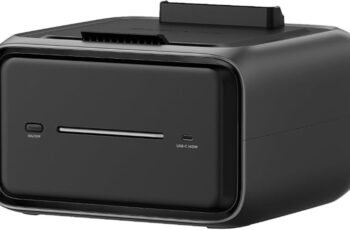
We’re examining whether the DJI Power 1000 delivers practical, dependable portable power beyond its headline specifications. Its 1024Wh LiFePO4 battery, 2200W continuous output, 800W solar input, and roughly 70-minute recharge make it suitable for backup power, camping, and demanding equipment. We’ll also weigh its 13 kg chassis, operating noise, safety features, and long-term battery life to determine where this power station excels—and where its size may become a limitation.
Key Takeaways
- The DJI Power 1000 delivers 2,200W continuous output and 2,640W peak power for appliances, tools, camping equipment, and drones.
- Its 1,024Wh LiFePO4 battery recharges in approximately 70 minutes via AC and supports up to 800W solar input.
- Durable battery cells provide up to 4,000 charge cycles, while integrated protections and a five-year warranty support long-term reliability.
- Charging noise is impressively low at 23dB, although high-power operation may become noticeably louder.
- At 13kg, the unit is powerful but bulky, with limited outlet flexibility and additional accessory costs affecting portability and value.
70-Minute Full Recharge
The DJI Power 1000 can reach a full charge in about 70 minutes from a standard grid outlet, reducing downtime between uses. We can treat this recharge speed as a practical advantage for emergency backup, camping, and demanding work sessions.
Its 1024Wh capacity provides substantial energy before the next recharge, while the LiFePO4 chemistry supports battery longevity through as many as 4,000 charge cycles.
We should note that real-world charging time may vary with outlet conditions and battery temperature. For routine use, the combination of rapid grid charging and durable cell chemistry helps us restore usable capacity quickly without sacrificing long-term reliability.
Detailed features
Beyond its 70-minute recharge, the DJI Power 1000 combines a 1024Wh LiFePO4 battery with 2200W of continuous output and 2640W of starting power, allowing us to run most household appliances, power tools, and camping equipment.
Its Battery technology supports up to 4,000 cycles, translating to roughly a decade of service under appropriate use.
We also get 800W solar input, two 140W USB-C ports, and dedicated DJI drone fast-charging support with compatible cables.
Integrated safety features include Battery Management System protections against over-current, over-voltage, and over-discharge.
At 23dB during charging, it remains unobtrusive in bedrooms, offices, and campsites.
Pros and Cons
We’ll weigh the DJI Power 1000’s strong output, rapid charging, durable LFP battery, and quiet operation against its 13 kg weight and accessory requirements.
We’ll also consider its high purchase cost and limited portability in practical use. This comparison will clarify whether its performance justifies the trade-offs.
Pros
Although it weighs 13 kg, the DJI Power 1000 delivers strong portable power with a 1,024Wh LiFePO4 battery, 2,200W continuous output, and 2,640W peak capacity.
We can run demanding appliances, tools, and camping equipment while charging phones or laptops through dual 140W USB-C ports.
Its 800W solar input and 70-minute AC recharge minimize downtime.
Battery longevity is another strength: LiFePO4 cells support up to 4,000 cycles, while the battery management system adds protection against electrical faults.
We’ll also appreciate its low noise levels, reaching just 23dB during recharging.
A five-year warranty further supports long-term reliability for backup or off-grid use.
Cons
The DJI Power 1000’s main drawbacks are its 13 kg weight and relatively bulky 44.8 × 22.5 × 23 cm design, which reduce portability for frequent carrying. We’ll also need to account for its limited outlet flexibility compared with some rivals and the separately sold drone charging cables.
Although its Battery lifespan reaches up to 4,000 cycles, frequent high-load use and improper storage can reduce real-world longevity.
Noise levels can fall to 23 dB during recharging, but faster, higher-power operation may sound louder.
Finally, the 800W solar input is impressive, yet achieving it requires strong sunlight and compatible panels, limiting consistent off-grid performance.
Concluding thoughts
In brief, we find the DJI Power 1000 to be a capable all-purpose power station that balances high output, rapid charging, and long-term durability. Its 2,200W output, 1,024Wh capacity, quiet operation, and 70-minute AC recharge suit home backup, camping, and tools.
| Strength | Practical value |
|---|---|
| LFP battery | Battery longevity, up to 4,000 cycles |
| Fast input | Less downtime between uses |
| 23dB operation | Comfortable indoors or outdoors |
The BMS manages over-current, over-voltage, and over-discharge risks, while 26 SGS Safety certifications strengthen confidence. We’d choose it for demanding portable power, accepting its 13kg weight and accessory costs as reasonable trade-offs for dependable performance and five-year warranty coverage.
Frequently Asked Questions
What Devices Are Included With the DJI Power 1000?
You’ll receive the DJI Power 1000 power station and an AC power cable. We should note that separately sold accessories support drone charging, while Battery capacity and Charging options describe capabilities, not included devices.
How Much Does the DJI Power 1000 Weigh?
Weighing approximately 13 kilograms, the DJI Power 1000 isn’t featherlight, but we can still transport it using its compact design. Its 1024Wh battery capacity balances substantial output with practical portability features for camping or backup power.
What Warranty Coverage Does DJI Provide?
DJI provides a five-year warranty for the Power 1000, covering manufacturing defects under stated warranty details. We should verify regional terms, exclusions, registration requirements, and battery capacity coverage before purchase.
Can the DJI Power 1000 Be Used Safely Indoors?
Yes, we can use the DJI Power 1000 safely indoors with ventilation, dry conditions, and clearances. For indoor safety, we’ll verify electrical compatibility, avoid overloading, and follow charging, grounding, and manufacturer instructions.
Does It Support Fast Charging for DJI Drones?
Yes—it supports fast charging for compatible DJI drones, including Mavic 3 and Air 3/3S, using separately sold cables. We get a 1024Wh battery capacity and excellent charging speed, extending flight time efficiently.
Conclusion
The DJI Power 1000 gives us dependable, flexible power for backup, camping, and demanding equipment. Its 1,024Wh LiFePO4 battery, 2,200W output, fast 70-minute recharge, and quiet operation create a strong balance of performance and practicality. At 13kg, it isn’t truly lightweight, but that’s a reasonable trade-off for durability and capacity. Need reliable energy without excessive noise or maintenance? We’d recommend it for users who value long-term safety, robust output, and versatile charging options.