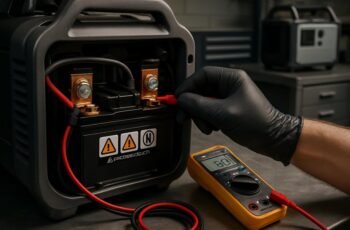
We monitor battery health with a data-driven, proactive approach, tracking SoC, SoH, temperature, impedance, and aging trends across cells, modules, and packs. We set clear thresholds, collect consistent sensor data, and translate it into actionable maintenance plans—balancing, cooling, charging discipline, and scheduled checkups. Our goal is early fault containment and lifecycle-aware scheduling, but the specifics you’ll need to implement will depend on your system’s sensors and use case. Let’s start mapping your baseline.
Key Takeaways
- Establish continuous data capture across cell groups, modules, and packs to monitor SoC, SoH, temperatures, and aging indicators.
- Use data-driven thresholds and alerts to detect deviations, enabling proactive maintenance and preventive conditioning.
- Track capacity fade, internal resistance rise, and calendar vs. usage aging to estimate remaining useful life.
- Implement calibrated charging practices and thermal management to minimize degradation and optimize reliability.
- Maintain baseline profiling, routine calibration, and automated alerts to guide targeted balancing and timely replacements.
Foundations of Battery Health Monitoring
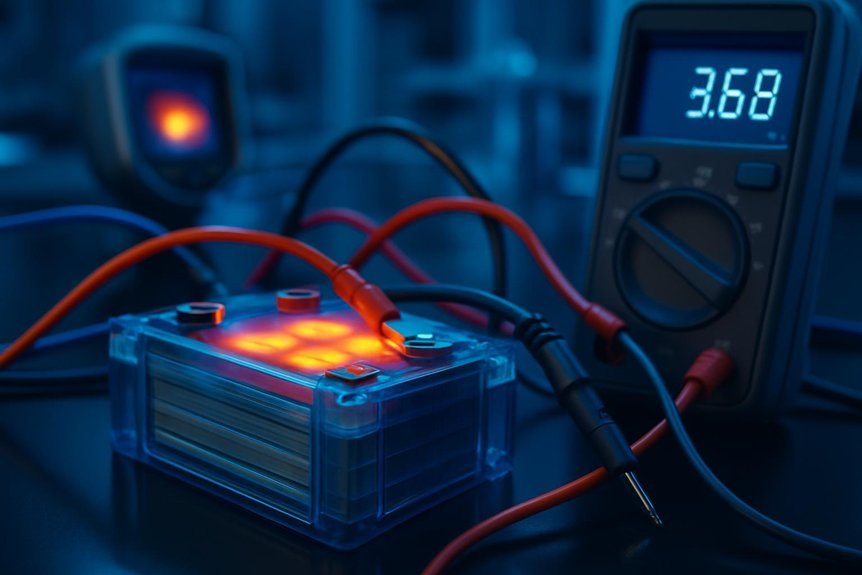
Battery health monitoring establishes the baseline metrics and real-time visibility we rely on to maintain performance, safety, and longevity. We begin with a systematic framework: establish measurement points across cell groups, modules, and packs; define acceptable ranges; and implement continuous data capture. Our approach emphasizes battery aging trajectories and electrolyte dynamics as core indicators of health, not anomalies. We quantify capacity fade, internal resistance shifts, and cycle-induced loss to forecast remaining useful life with confidence. We align sensor fidelity, calibration cadence, and fault-tolerance to minimize drift and false alarms. Proactive maintenance emerges from trend analysis, anomaly detection, and robust logging. By codifying procedures for data review, we ensure rapid containment, targeted balancing, and preventive conditioning, keeping performance consistent while avoiding unnecessary interventions.
Key Battery Health Indicators: SoC, SoH, and Temperature Thresholds
We monitor State of Charge limits, State of Health trends, and temperature threshold alerts to guide proactive maintenance decisions. By tracking SoC boundaries, WeH trajectories, and hotspot notifications, we detect deviations that impact performance and lifespan. Our approach combines data-driven thresholds with timely alerts to sustain reliability and optimize scheduling.
State Of Charge Limits
How do we define safe operating boundaries for State of Charge (SoC) in a battery system? We establish fixed minimum and maximum SoC limits based on cell chemistry, age, and intended duty cycle, then verify them against real-time monitoring data. Our approach prioritizes voltage stability, preventing overcharge and deep discharge episodes that degrade cycle life. We set conservative ceilings during high-temperature periods and aggressive limits during low-temperature operations, recalibrating as cells age or when impedance trends shift. We implement guard bands to account for sensor drift and transient load spikes, ensuring conservative margins without sacrificing availability. Regularly review SOC boundary performance using coulombic efficiency, capacity fade rates, and anomaly flags to sustain reliable energy delivery and predictable maintenance planning.
State Of Health Trends
Are there clear, actionable indicators that reveal how a battery’s health evolves over time? We answer yes, by tracking SoH trends alongside SoC dynamics and temperature thresholds. Our approach emphasizes data-driven trajectories: the rate of capacity loss, cycle life degradation, and resistance rise map battery aging with precision. We monitor calendar aging vs. usage aging to distinguish intrinsic wear from operational stress, then quantify remaining useful life through degradation models and confidence intervals. We prioritize actionable signals, such as accelerating capacity fade, widening charge-discharge hysteresis, and abnormal self-discharge patterns, prompting proactive maintenance. We also consider cell balancing effectiveness, ensuring uniform aging across modules to prevent localized faults. Continuous health trending informs maintenance scheduling, BMS calibrations, and preventive interventions.
Temperature Threshold Alerts
Temperature thresholds are our frontline guardrails for battery health, signaling when SoC, SoH, and thermal conditions deviate from safe operating envelopes. We monitor thresholds continuously, calibrating alert bands to reflect current load profiles, ambient conditions, and aging effects. When temperature crosses preset limits, our systems trigger immediate notifications, instructing disciplined responses: reduce charging current, pause high-demand operations, or initiate thermal management sequences. We quantify alert confidence with historical baselines, rate of change, and dwell time, ensuring distinctions between transient spikes and persistent excursions. Thresholds are not passive signals; they guide proactive maintenance, prompting diagnostics, cell balancing, and electrolyte checks if needed. Empty warnings gain context through trend analysis, while irrelevant events are suppressed to maintain operator focus and operational reliability.
Collect Battery Data: Essential Tools and Sensors
To collect reliable battery data, we deploy a core set of tools and sensors that monitor voltage, current, temperature, impedance, and state of charge in real time, enabling us to detect anomalies before they escalate. We rely on robust data logging to timestamp and archive measurements, and perform regular sensor calibration to ensure accuracy across cycles. Our approach prioritizes repeatability, traceability, and rapid fault isolation.
- Real-time monitoring of voltage, current, and temperature
- Impedance and state of charge tracking for health assessment
- Data logging infrastructure with secure, time-synced records
- Routine sensor calibration and validation to maintain precision
What Your Battery Numbers Really Mean
Interpreting battery numbers starts with translating raw measurements into actionable health insights. We translate capacity, state of health, impedance, and cycle counts into concrete trends that signal risk or reliability. When we examine capacity versus design spec, we quantify degradation rate and forecast remaining runtime under typical usage. Impedance rise reveals internal aging and heat susceptibility, guiding cooling and load management. Cycle counts illuminate wear balance with depth of discharge patterns, enabling precise maintenance windows. We consider battery management system alerts as data points, not alarms, and we calibrate them against calibration drift and environmental effects. We also reflect on user sessions: the future, noting how data privacy and aggregation influence our protocols. Ethical considerations shape how we share insights, prioritize safety, and plan transparent energy strategies.
Proactive Maintenance: Schedule Preventive Checks
We schedule regular checkups and establish a preventive maintenance cadence to keep battery health predictable. By tracking metrics and trends, we base our preventive actions on data rather than guesswork. This proactive routine minimizes unplanned downtime and extends overall system reliability.
Schedule Regular Checkups
How often should we schedule maintenance is a question we answer with data: regular checkups catch wear early, reduce unexpected outages, and extend battery life. Our approach is data-driven, focusing on actionable signals like battery aging indicators and thermal drift trends to guide timing and scope of visits. We structure checkups to verify capacity vs. rating, inspect cell balance, and confirm cooling performance, then document deviations for trend analysis. Consistency in cadence improves predictive accuracy and minimizes risk. We tailor frequency to usage, environment, and criticality, while maintaining rigorous records for auditability.
- Establish baseline measurements and track delta over time
- Monitor capacity, internal resistance, and thermal behavior
- Review charging/discharging profiles for anomalies
- Document findings for continuous improvement
Preventive Maintenance Cadence
Preventive maintenance cadence is about planning proactive checks that minimize risk and maximize battery life. We outline a cadence that blends data, risk, and workload to sustain performance. We rely on objective signals like cycle counting and aging indicators to schedule interventions before degradation escalates. Our approach emphasizes regular inspections, parameter tracking, and documented actions, all aligned with device usage patterns and environmental factors. We avoid reactive patching and focus on preserving capacity and efficiency through disciplined timing and verifiable results. By continuously monitoring battery aging trends and cycling data, we can fine-tune maintenance windows and parts replacement. This disciplined cadence reduces unexpected failures and extends life across our fleet, delivering predictable reliability.
Charging Habits to Protect Battery Longevity
Are charging habits a decisive factor in extending battery life? Yes, we observe measurable effects from our charging protocols. We implement data-driven, proactive steps to minimize degradation while maintaining readiness. Our approach emphasizes disciplined cycles, calibrated thresholds, and consistent monitoring to maximize usable life. Key practices include adopting charging ethics that balance speed with cell health and applying discharge strategies that avoid deep discharges. We stay vigilant for variance in performance and adjust thresholds accordingly.
Yes—our data-driven charging strategy extends usable life through disciplined cycles, calibrated thresholds, and vigilant monitoring.
- Maintain partial-state charging windows to reduce depth of discharge
- Use calibrated chargers and avoid high-current bursts during peak aging
- Schedule regular top-ups rather than infrequent full charges
- Prioritize charging window alignment with usage patterns and thermal baselines
Thermal Management for Battery Health Under Load
We’ll examine how thermal load affects battery health under operation, focusing on thermal load considerations, cooling system efficiency, and safe temperature cutoffs. Our goal is to quantify heat generation, assess cooling performance under varying loads, and establish precise safety thresholds to prevent degradation. By integrating real-time monitoring with proactive maintenance, we’ll guarantee stable temperatures and rapid responses to any cooling inefficiency.
Thermal Load Considerations
Thermal load critically influences battery health under operation, and managing it proactively requires precise, data-driven monitoring of temperature, current, and ambient conditions in real time. We analyze how heat production scales with load, how heat moves through materials, and how thermal mass buffers excursions. Our approach emphasizes measurable indicators, trend analysis, and actionable thresholds to prevent degradation and capacity loss. We align data collection with behavior under varying duty cycles, storage states, and ambient environments, ensuring safeguards remain within design margins. Key factors include heat transfer pathways, material interfaces, and the impact of rapid transients on cell integrity. By documenting responses, we refine predictive maintenance and minimize thermal wear.
- Heat transfer pathways and interfaces
- Thermal mass buffering effects
- Transient response to load changes
- Data-driven thresholding and alerts
Cooling System Efficiency
Efficient cooling is essential to sustain battery health under load, and we quantify it through measured coolant flow, inlet/outlet temperatures, and heat rejection rates to identify gaps between actual and design performance. We then translate findings into actionable maintenance steps, focusing on battery cooling and thermal conduction pathways. Our approach emphasizes data-driven checks, proactive calibration, and rapid corrective actions when deviations arise.
| Parameter | Measured Value | Design Target |
|---|---|---|
| Coolant Flow | 3.2 L/min | 3.5 L/min |
| Inlet Temp | 28.4°C | 25°C |
| Heat Rejection | 420 W | 500 W |
This table guides us to optimize flow, minimize thermal resistance, and sustain performance under load through disciplined monitoring and targeted adjustments. Regular audits prevent hotspots and extend long-term reliability.
Temperature Cutoffs and Safety
Temperature cutoffs define safe operating envelopes under load, and we set them based on measured thermal responses, material limits, and safety margins. We target reliable performance by aligning cutoffs with real-time temperature data, charge/discharge profiles, and thermal inertia. Our approach emphasizes battery chemistry behavior under varying loads, ensuring margins account for aging and ambient conditions. We implement strict safety protocols, documenting excursions, and triggering mitigations before thresholds are breached.
- Real-time monitoring aligns temperatures with safe zones for each cell group
- Cutoffs reflect both peak and average thermal responses during load cycles
- Safety protocols trigger cooling or derating to prevent thermal runaway
- Validation includes post-event analysis and iterative tuning of thresholds
DIY Diagnostic Routines and When to Call a Pro
What diagnostic routines should we run ourselves, and when is it wiser to call a pro? We start with baseline data: log voltage, current, and temperature under known loads, then compare to manufacturer curves for our battery chemistries. We perform impedance checks and open-circuit voltage tests after rest periods, noting drift over cycles. Visual inspections focus on housing materials for swelling, corrosion, or leaks, and connector integrity. Battery management system logs help pinpoint cell imbalance, state of health, and SOC- tracking anomalies. If data deviate beyond predefined thresholds or safety flags trigger, escalate to a professional for advanced diagnostics, including cell-by-cell resistance, thermal imaging, and electrolyte analysis. Regular, documented checks reduce risk and guide maintenance without unnecessary replacements.
Planning Replacements: When to Service or Swap Cells
From the baseline diagnostics we’ve outlined, planning when to service or swap cells hinges on objective thresholds and observed trends. We translate data into actionable decisions by tracking capacity fade, internal resistance rise, and calendar aging under load. Our approach prioritizes planning replacements before failures, while accounting for aging considerations and risk to the system. We also assess cell balancing efficiency, cooling impact, and pack health to refine timing. By setting clear replacement timing criteria, we minimize downtime and maximize safety.
- planning replacements criteria based on capacity, resistance, and temperature trends
- trigger points tied to aging considerations and safety margins
- evaluation of cell balancing effectiveness before swapping
- lifecycle-based scheduling to reduce unexpected outages and maintain reliability
Building a Simple Battery Health Routine for Any System
How can we establish a simple, reliable battery health routine that works across systems? We design a transferable protocol that emphasizes measurable signals over opinion. Begin with baseline profiling: capture battery chemistry characteristics, full-cycle impedance, capacity, and charge-discharge curves. Establish a core cadence—weekly quick checks and monthly deep diagnostics—formatted to minimize disruption. Track voltage drift under identical load and temperature conditions, flagging deviations beyond predefined thresholds. Use standardized test charges, record peak voltages, and compare against manufacturer specs and historical data. Automate alerts for abnormal trends, and document corrective actions with clear ownership. Regularly recalibrate data models as aging proceeds, adjusting maintenance windows accordingly. This disciplined approach yields early fault detection, actionable insights, and a robust framework for any system, with a focus on reliability and data-driven stewardship.
Frequently Asked Questions
How Often Should I Calibrate Battery Gauges for Accuracy?
We calibrate every six months to ensure meter accuracy and reliable readings; our calibration cadence aligns with manufacturer specs and field data, allowing proactive maintenance. We track drift, document results, and adjust procedures to sustain high calibration cadence.
What’s the Minimum Data I Need for Health Assessment?
We require the minimum data: current capacity, voltage, temperature, state of charge, and cycle count for a robust health assessment; calibration basics ensure gauge accuracy, while ongoing monitoring drives proactive maintenance and data-driven decisions.
Do Cheap Sensors Skew Health Readings Significantly?
We answer: cheap sensors can skew readings, so we cautiously trust trends over absolute values. We’ll calibrate, cross-validate, and apply redundancy, ensuring data-driven, proactive maintenance despite cheap sensors and inevitable drift affecting early decisions.
Can Software Updates Affect Battery Monitoring Accuracy?
Software updates can affect battery monitoring accuracy, we’ve seen calibration shifts and sensor timing variances after patches, so we’ll verify readings post-update, log discrepancies, and recalibrate as needed to maintain data-driven, proactive maintenance standards.
How Long Should a Battery Health Baseline Be Maintained?
We should maintain a battery health baseline for 12–24 months, balancing data retention with meaningful trends; we monitor battery lifespan metrics and recalibrate regularly to detect deviations early and sustain predictive accuracy.
Conclusion
We balance data-driven rigor with proactive care, showing how numbers translate into actions. Juxtaposing real-time sensor streams against aging trends, we reveal a clear path from anomaly to intervention. When SoC and SoH drift, thresholds alert us; when temperature climbs, cooling steps deploy. We don’t chase vague assurances—we schedule preventive checks, calibrate devices, and plan replacements before failures. In this disciplined rhythm, reliability, safety, and usable energy cooperate, extending lifecycle while minimizing risk.