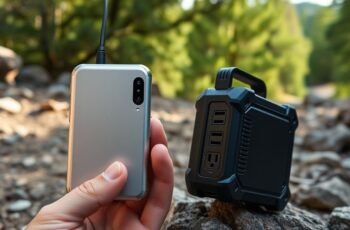
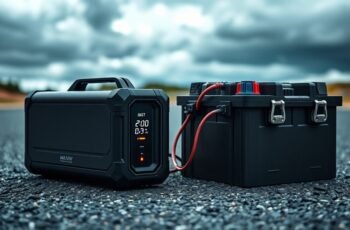
While portable power stations offer immediate, plug-and-play solutions, deep cycle batteries provide a more durable, long-term energy storage option; choosing between them hinges on specific application needs. Each system presents distinct technical advantages and limitations, influencing performance, scalability, and cost over time. Understanding these differences is essential for making an informed decision that aligns with your power requirements and environmental considerations. Let’s explore how each setup functions and where they best fit.
Key Takeaways
- Portable power stations are integrated, compact units with in-built inverters, ideal for short-term, mobile power needs.
- Deep cycle batteries support long-term, steady power delivery, suitable for off-grid and renewable energy applications.
- Power stations offer quick deployment and ease of use, while deep cycle batteries require more handling and setup.
- Deep cycle batteries typically have longer lifespan and higher scalability for large-scale or extended-use projects.
- Portable stations usually involve higher upfront costs but require less maintenance compared to deep cycle battery setups.
How Do Portable Power Stations Work and What Are Their Main Benefits?
Portable power stations operate by converting stored electrical energy into usable power through integrated inverter systems, allowing for versatile application across various devices. They typically incorporate a battery management system (BMS) that optimizes battery health and longevity, ensuring efficient energy use. When paired with solar panels, these stations can harness renewable energy, making them ideal for off-grid or emergency scenarios. The solar panel charges the internal battery, which provides a stable supply of power via the inverter, suitable for laptops, small appliances, or lighting. The combination of solar input and sophisticated battery management enhances durability and performance, reducing maintenance needs. This integration makes portable power stations a reliable, flexible solution for continuous, clean energy, especially in situations where traditional power sources are unavailable or impractical.
What Are Deep Cycle Batteries, and When Should You Use Them?
Deep cycle batteries are designed for sustained, long-term power storage, making them suitable for applications requiring consistent energy output over extended periods. They are especially effective in off-grid setups where reliable, renewable energy sources are essential. Understanding their capabilities helps determine ideal scenarios for their deployment.
Long-Term Power Storage
When considering long-term power storage solutions, deep cycle batteries are specifically designed to provide consistent energy over extended periods, making them ideal for applications requiring reliable, sustained power. Their ability to handle repeated deep discharges enhances longevity, which is vital for solar integration systems aiming for stability over time. Compared to portable power stations, deep cycle batteries typically have a higher energy density and longer cycle life, although they are heavier—highlighting a significant weight comparison factor. This increased weight may impact installation and transportation but offers superior durability and capacity for continuous power needs. Their stability and deep discharge capabilities make them essential for extended storage, ensuring a steady power supply without frequent recharging, which is fundamental for off-grid or backup applications.
Ideal For Off-Grid Use
Ever wondered why deep cycle batteries are often the preferred choice for off-grid power systems? Their ability to deliver consistent, reliable power over extended periods makes them ideal for such applications. Unlike traditional batteries, deep cycle models are designed to withstand deep discharges without damage, guaranteeing longevity and peak performance. Their robust construction supports repeated cycling, which is essential for off-grid setups where grid power isn’t available. While aesthetic design might seem secondary, a sleek, durable casing from reputable brands signals quality and reliability. Brand reputation plays a vital role, as trusted manufacturers often guarantee higher standards, better warranties, and consistent performance. Overall, deep cycle batteries are the practical, durable, and dependable choice for those seeking sustainable off-grid energy solutions.
Comparing Power Output: Which Is More Suitable for High-Drain Devices?
Though both portable power stations and deep cycle batteries are capable energy sources, their ability to handle high-drain devices varies considerably. Power output depends on battery chemistry; lithium-ion-based stations typically deliver higher surge currents and sustained power compared to lead-acid deep cycle batteries. This makes portable stations more suitable for high-drain devices like power tools or inverters. Deep cycle batteries, while reliable for steady, lower-current loads, struggle with rapid power demands. Additionally, renewable integration influences performance; power stations often feature advanced power management systems that optimize high-drain loads and facilitate renewable energy input, enhancing overall efficiency. In contrast, traditional deep cycle batteries generally lack such sophisticated management, limiting their capacity for handling sudden, high-power demands.
Ease of Use and Portability: Which Setup Fits an Active Lifestyle?
Evaluating ease of use and portability requires examining the design characteristics and practical handling of both setups. Portable power stations typically feature integrated handles, compact form factors, and user-friendly interfaces, making them ideal for active lifestyles. Their lithium-based battery chemistry offers high energy density and rapid charging speeds, enabling quick setup and minimal downtime. Deep cycle batteries, often larger and heavier, lack these conveniences, requiring careful handling and additional equipment for transportation. While they may provide longer-term energy storage, their bulkiness and slower charging speeds make them less adaptable for frequent mobility. Overall, portable power stations deliver superior ease of use and portability, aligning better with dynamic, on-the-go applications where quick deployment and convenience are priorities.
Cost Considerations: Which Option Is More Budget-Friendly Over Time?
When comparing the long-term cost-effectiveness of portable power stations and deep cycle batteries, it’s crucial to take into account initial investment, maintenance expenses, and lifespan. Our cost analysis indicates that deep cycle batteries typically have a lower upfront cost but may incur higher battery replacement costs over time due to limited cycle life. Portable power stations often involve a higher initial expense but tend to require less frequent maintenance and have integrated components designed for durability. Over extended use, the total cost of ownership depends heavily on the frequency of battery replacements and the durability of each setup. Consequently, evaluating both options involves balancing initial capital against ongoing expenses, with deep cycle batteries potentially becoming more cost-effective if replacements are infrequent and the lifespan is maximized.
Battery Life and Durability: Which Setup Lasts Longer in the Field?
Understanding the longevity of power setups requires examining how well each option withstands continuous use in the field. Deep cycle batteries typically excel in durability due to their robust battery chemistry, often supporting 2000-5000 charging cycles. Portable power stations, incorporating advanced lithium-ion chemistries, offer high cycle counts but may degrade faster under extreme conditions. The structural design and quality of internal components also influence durability.
| Feature | Deep Cycle Battery | Portable Power Station |
|---|---|---|
| Battery Chemistry | Lead-acid or lithium-ion | Lithium-ion (advanced) |
| Estimated Charging Cycles | 2000-5000 | 1000-3000 |
| Durability Factors | Robust, field-tested | Sensitive to temperature |
| Longevity in Field | Generally longer-lasting | Slightly shorter lifespan |
Both setups provide reliable service, but deep cycle batteries tend to sustain longer operational life in demanding environments.
Charging and Recharging: How Do You Maintain and Replenish Power?
Maintaining and replenishing power in portable energy setups involves carefully managing the charging process to maximize battery life and performance. The effectiveness of this process hinges on understanding battery chemistry, as different chemistries—such as lithium-ion or lead-acid—respond uniquely to charging protocols. Proper management of charging cycles is critical; frequent or improper charging accelerates capacity loss and diminishes longevity. For portable power stations, rapid charging with high current can impact battery chemistry adversely, reducing cycle life. Conversely, deep cycle batteries often require controlled, gradual charging to preserve electrochemical integrity. Monitoring voltage, temperature, and current during charging ensures ideal conditions and prevents thermal stress. Ultimately, balancing charging parameters aligned with battery chemistry prolongs the effective lifespan while maintaining efficient power replenishment.
Ideal Use Cases for Portable Power Stations vs Deep Cycle Batteries
We need to evaluate how portability, power duration, and environmental conditions influence the ideal choice between portable power stations and deep cycle batteries. Portable power stations excel in scenarios requiring mobility and quick deployment, while deep cycle batteries are suited for sustained, high-capacity applications in stable environments. Analyzing these factors helps identify which setup best aligns with specific use cases.
Portability and Mobility
While both portable power stations and deep cycle batteries offer mobility, their design and functionality determine their ideal use cases. Portable power stations excel in scenarios prioritizing quick deployment, thanks to their integrated battery chemistry that allows rapid charging and discharging. They are also optimized for weight considerations, making them suitable for transport in outdoor or emergency settings. Conversely, deep cycle batteries are better suited for stationary or semi-permanent applications where weight is less critical but longer-term energy storage is essential. Specifically:
- Portable power stations are ideal for short-term, high-mobility tasks due to their manageable weight and built-in features.
- Deep cycle batteries, while heavier, provide sustained power over extended periods, favoring fixed or semi-portable setups.
- The choice hinges on balancing battery chemistry, weight considerations, and the required mobility level for the intended application.
Extended Power Duration
Extended power duration is a critical factor when selecting between portable power stations and deep cycle batteries, as each system is designed to optimize different operational priorities. Deep cycle batteries typically provide longer-lasting energy, making them suitable for renewable integration projects requiring sustained power over days or weeks. Portable power stations excel in delivering quick, flexible energy but generally have shorter endurance.
| Feature | Portable Power Station | Deep Cycle Battery |
|---|---|---|
| Power Duration | Shorter, portable use | Extended, stable output |
| Renewable Integration | Limited, supplemental | Ideal for continuous use |
| Safety Considerations | Built-in safeguards | Proper handling required |
| Ideal Use Cases | Emergency, camping | Off-grid, long-term setups |
Usage Environment Suitability
Choosing the appropriate power system depends heavily on the specific environment and operational demands. Portable power stations excel in environments requiring mobility, quick deployment, and minimal setup, such as outdoor events or emergency situations. They typically use lithium-ion battery chemistry, which offers high energy density and fast recharge times, but can have a higher environmental impact due to resource extraction. Conversely, deep cycle batteries are suitable for stationary or semi-permanent installations like off-grid solar systems, where long-term reliability and cycle life matter. They often employ lead-acid or advanced lithium chemistries, which influence environmental impact and recyclability.
- Mobility needs versus stationary applications
- Environmental impact of battery chemistry
- Deployment complexity and maintenance
Which Setup Offers Better Scalability for Larger Power Needs?
When evaluating scalability for larger power demands, portable power stations and deep cycle battery setups differ markedly in their modular capabilities. Portable stations excel in quick, integrated solutions suitable for emergency preparedness and renewable integration, but they face limits in expanding capacity. Deep cycle batteries, however, offer scalable modularity through serial or parallel configurations, allowing for customized capacity increases. This flexibility benefits large-scale applications, such as off-grid solar systems or extended power needs. The table below illustrates the core differences:
| Feature | Portable Power Station | Deep Cycle Battery Setup |
|---|---|---|
| Modular Expansion | Limited, integrated design | High, modular battery banks |
| Renewable Integration | Moderate, with inverter capabilities | High, scalable for renewable sources |
| Emergency Preparedness | Rapid deployment, portable | Extended capacity, customizable |
This comparison highlights deep cycle batteries’ superior scalability.
Making the Right Choice: Factors to Consider Based on Your Power Requirements
Evaluating your specific power requirements is essential to making an informed decision between a portable power station and a deep cycle battery setup. Key considerations include:
Assess your power needs carefully to choose between portable stations and deep cycle batteries effectively.
- Power output and duration: Determine if your needs are short-term and portable or require sustained, high-capacity energy for extended periods.
- Integration and expandability: Assess how well each setup supports solar integration for renewable energy applications and future scalability.
- System complexity and maintenance: Consider the technical complexity, maintenance needs, and ease of deployment, especially for remote or off-grid use.
Frequently Asked Questions
Can Portable Power Stations Be Integrated With Solar Panels?
Yes, portable power stations often feature solar panel compatibility, enhancing their power station portability; we analyze their integration, noting that efficient solar input expands off-grid capabilities, making them ideal for renewable energy applications and remote power needs.
How Long Does It Take to Fully Recharge a Deep Cycle Battery?
Like a well-oiled machine, a deep cycle battery typically recharges in 4 to 12 hours depending on its capacity and charging method. Proper maintenance extends its lifespan, ensuring peak performance over many cycles.
Are Portable Power Stations Suitable for Emergency Backup?
We find portable power stations suitable for emergency backup due to their high battery lifespan and ease of portability, despite some concerns about portability. They provide reliable, quick power access, making them an effective, versatile solution for emergency situations.
What Maintenance Is Required for Deep Cycle Batteries?
We perform regular inspections, guarantee proper charging, and keep terminals clean to extend battery lifespan, minimizing maintenance costs. Monitoring voltage levels helps prevent over-discharge, ensuring deep cycle batteries operate efficiently and last longer with ideal performance.
Which Setup Is Better for Off-Grid Living?
Like choosing between a reliable compass and a Swiss Army knife, we find deep cycle batteries offer longer lifespan, but portable power stations excel in portability considerations for off-grid living, making them more adaptable for various energy needs.
Conclusion
Ultimately, choosing between a portable power station and a deep cycle battery setup depends on your specific needs. If mobility and quick deployment matter most, a power station offers flexibility and convenience. For long-term, stable energy supply, deep cycle batteries excel in durability and capacity. As the saying goes, “You get what you pay for,” so weigh your power demands carefully. Making an informed decision guarantees reliable, efficient energy tailored to your lifestyle.