Recent field data show that aging batteries contribute to outages 30–40% more often than planned maintenance detects. We’re exploring how tools—from handheld impedance meters to advanced analyzers and data loggers—fit into a standard, auditable testing process. We’ll probe SOH, SOC, and IR with repeatable procedures, ensure traceable calibration, and align maintenance plans with measured risk. If you want a reliable outage-ready operation, consider what gaps you still need to close.
Key Takeaways
- Use advanced battery analyzers for multi-parameter tests: SOC, SOH, IR, temperature, and impedance under controlled profiles.
- Employ handheld impedance meters for quick, on-site checks of module health and uniform impedance.
- Implement monthly maintenance tests with predefined acceptance criteria, safety controls, and traceable data logs.
- Perform controlled charge/discharge and energy profiling to assess capacity retention and safety channel integrity.
- Establish calibrated measurement protocols and documentation to ensure repeatability, data integrity, and lifecycle insights.
Why Battery Health Matters Before an Outage
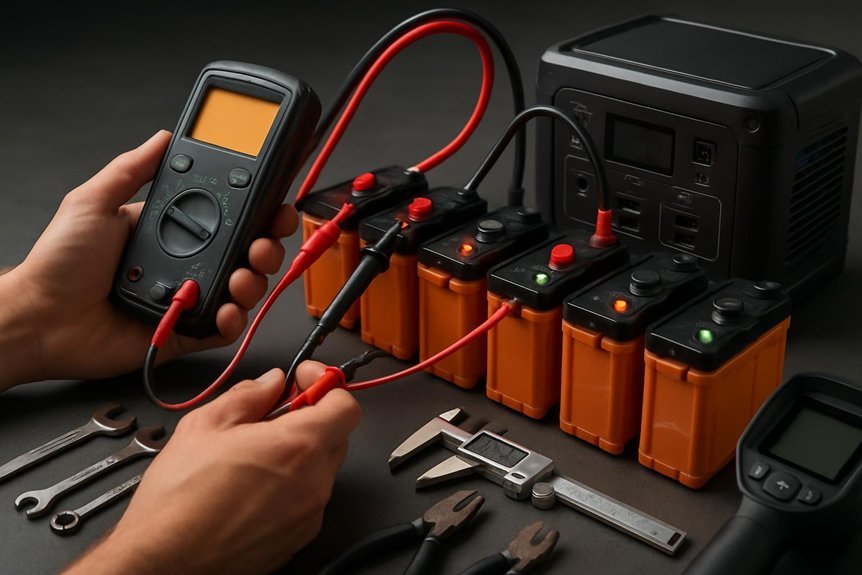
Maintaining battery health before an outage isn’t optional—it’s essential. We examine how preemptive care preserves reliability, enabling predictable performance when demand spikes. Our approach emphasizes conservative design margins, repeatable tests, and documented procedures aligned with standards. We assess aging indicators tied to battery aging trends, ensuring early detection of capacity fade and impedance growth. By validating charging protocols under representative loads, we confirm that state of charge remains within safe bands during idle and cycling scenarios. We implement controlled discharge and recharge cycles to reveal capacity retention, temperature rise, and safety channel integrity. This disciplined process minimizes risk of premature failure, extends usable life, and guarantees readiness. Readers gain a precise, testable framework for proactive health management before outages.
What to Measure: SOH, State of Charge, and Internal Resistance
To assess battery health and performance reliably, we focus on three core metrics: State of Health (SOH), State of Charge (SOC), and internal resistance. In this section, we quantify each parameter with repeatable, standards-aligned methods. SOH reflects capacity fade and cycle aging, while SOC indicates available energy relative to design capacity. We measure SOH and SOC through controlled discharge/charge profiles under defined temperature and current limits, logging capacity, voltage recovery, and state estimates. IR vs impedance characterization isolates polarization effects and conductor losses, informing thermal and aging behavior. We compare soh vs soc trends over time to detect abnormal degradation. Our approach emphasizes traceable instrumentation, clear thresholds, and documented acceptance criteria, ensuring consistent interpretation across devices and developers, with data-driven decisions guiding maintenance and replacement timelines.
Quick Checks With Handheld Impedance Meters
We use handheld impedance meters for quick, on-site checks that complement full-capacity tests. We approach Battery testing with a focus on repeatable measurements and traceable results. By applying impedance basics, we verify resistance and phase angle within defined limits to detect loose connections, corrosion, or degraded cells. Our procedures follow metrology methods that ensure calibration status, test current, and measurement uncertainty are documented for each session. We perform rapid checks across the string, noting any drift between cells and confirming uniform impedance distribution. These readings guide Maintenance planning, allowing us to flag suspect modules for detailed follow-up. We emphasize consistency, record keeping, and adherence to standard-compliant protocols, using the data to refine test schedules and asset reliability without substituting deeper analyses when warranted.
When to Use Advanced Battery Analyzers for Precision
Advanced battery analyzers are warranted when high-precision parameterization is required beyond impedance checks. We’ll outline when to deploy these tools to ensure reliable, repeatable results. Our approach emphasizes traceable methods, defined tester thresholds, and documented repeatability to support informed decisions.
- Use advanced analyzers for precision analysis when state-of-health indicators must be quantified beyond simple impedance and voltage trends.
- Apply when temperature, charge/discharge profiles, and internal resistance changes require synchronized, multi-parameter capture and correlation.
- Establish criteria with documented thresholds and pass/fail criteria to guarantee consistency across tests and operators.
We stay action-focused: validate results against calibration standards, document uncertainties, and ensure data integrates with maintenance records for robust lifecycle assessments.
Building a Maintenance Test Plan You Can Execute Monthly
Monthly maintenance builds on proven testing methods by codifying a repeatable, auditable plan. We present a maintenance plan that supports reliable monthly execution, aligned with standard requirements and test-driven expectations. Our approach defines scope, objectives, and acceptance criteria for each routine, ensuring consistency across cycles. We detail pre-test checklists, safety controls, and data capture methods to enable traceability and root-cause analysis. The plan standardizes test sequences, instrument calibration, and environmental logging, so results are comparable over time. We emphasize risk-based prioritization, documenting critical-path tests and fallback procedures. By integrating maintenance planning with performance baselines, we enable proactive interventions rather than reactive repairs. This structure supports continuous improvement, clear accountability, and auditable records, empowering readers to execute sustainable, compliant, and verifiable monthly execution of battery condition assessments.
Frequently Asked Questions
How Often Should I Recalibrate Impedance Meters for Accuracy?
We should recalibrate impedance meters every six months to maintain accuracy. This recalibration cadence accounts for impedance meter aging, ensuring test-driven, standard-compliant results; we verify with calibration standards and document any drift, addressing measurement integrity proactively.
Can Battery Testing Harm the Battery or Reduce Lifespan?
We answer: yes, improper testing can harm the cell and shorten lifespan; follow battery safety and test procedures strictly, using calibrated equipment, controlled load, and conservative limits to avoid thermal stress or over-discharge.
What Minimum Tool Set Is Needed for Field Testing?
Flagship like a compass, our minimum field tool set includes a multimeter, clamp meter, portable battery tester, insulated gloves, safety glasses, and a fuse-protected supply; we emphasize battery safety and field setup for precise, standard-compliant results.
Which Certifications Verify Reliability of Battery Test Equipment?
We verify reliability of battery test equipment via certification standards and reliability metrics, ensuring conformity with industry tests, calibration traceability, and documented test procedures; our team conducts rigorous assessments to sustain accuracy, repeatability, and compliant performance for critical power stations.
How to Interpret Test Results for Aged vs. New Packs?
Aged pack interpretation contrasts with New pack benchmarks, guiding our evaluation. We interpret results rigorously, noting deviations, state-of-health, and capacity fade, while ensuring test-driven, standard-compliant criteria. We present actionable thresholds for both scenarios, reader.
Conclusion
We wrap up by reaffirming that a disciplined, test-driven approach to battery condition is non-negotiable for outage readiness. By routinely measuring SOH, state of charge, and internal resistance with calibrated tools, we detect faults long before they cascade. Our maintenance plan—monthly, standardized, and auditable—ensures traceability across handheld meters, analyzers, and loggers. Stay vigilant, document every result, and treat anomalies as urgent. This level of rigor makes reliability feel like an absolute superpower.