In a recent plant retrofit, we tracked capacity fade and rising internal resistance to flag a looming inverter trip. We’ll define battery health for power stations, identify essential data streams, and benchmark them against baselines in real time. By normalizing metrics, unifying streams, and applying proactive thresholds, we can build dashboards and alert tiers that guide maintenance before outages occur. Join us as we map governance, lineage, and fault diagnosis to sustain reliability and availability.
Key Takeaways
- Define battery health by capacity, internal resistance, cycle life, and thermal stability against manufacturer specs and site conditions.
- Track remaining capacity, state of health, SOC accuracy, and impedance trends to quantify health and predict end-of-life.
- Normalize health metrics to a baseline, monitor drift, temperature stability, voltage recovery, and sulfation indicators.
- Consolidate essential data streams (operational, thermal, electrical, environmental) with data federation and quality gates.
- Implement proactive monitoring with real-time alerts, baselined thresholds, and a data-driven maintenance plan.
Define Battery Health for Power Stations
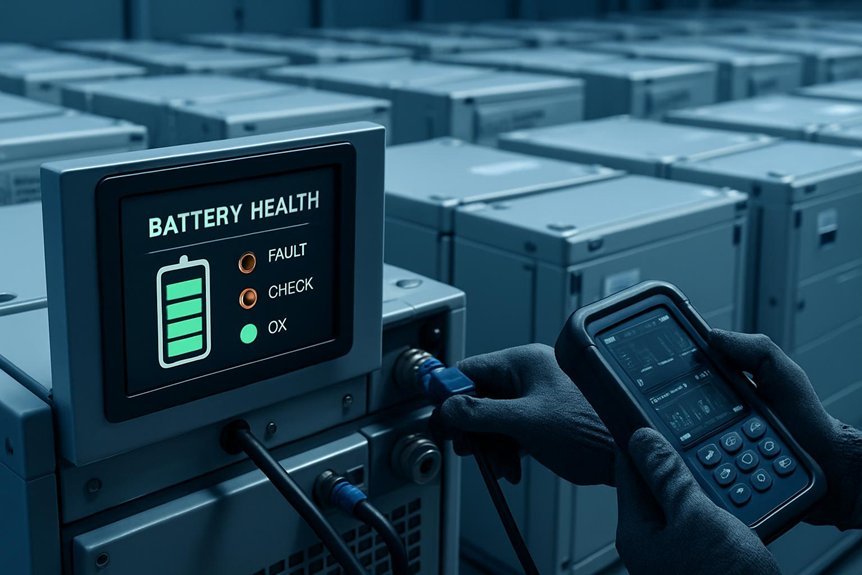
Battery health for power stations describes the current ability of a battery system to store and deliver specified energy and power while meeting design life and reliability targets. We define health as a measurable state rooted in performance, degradation, and availability. Our assessment centers on capacity, internal resistance, cycle life, and thermal stability, all compared against manufacturer specifications and site operating conditions. Data quality governs credibility: we validate sensor accuracy, calibration history, and cross-check with independent tests. Data latency matters: near real-time updates enable timely decisions on charging discipline, thermal management, and preventive maintenance. We quantify health with metrics such as remaining capacity, state of health, and expected end-of-life. By standardizing terminologies and thresholds, we ensure repeatable, objective evaluations across batteries, modules, and banks within the station.
Identify and Organize Essential Data Streams
To monitor health effectively, we must identify and organize the essential data streams that feed our metrics. We map inputs by source, frequency, and reliability, then classify them into operational, thermal, electrical, and environmental groups. We prioritize durability metrics—cycle counts, SOC accuracy, voltage drift, and temperature ramp rates—to anchor health assessments. We implement data federation to unify disparate systems, enabling a single authoritative stream for dashboards and alerts. We define data quality gates: completeness, timeliness, and consistency, with automated validation rules at ingestion. We document data lineage, ownership, and retention, so teams align on context and usage. Finally, we establish a minimal viable data set that scales, validating it against planned KPIs before expanding streams. This disciplined approach keeps our monitoring precise and actionable.
Interpret Core Indicators to Measure Health
We’ve identified and organized the data streams, so we can now interpret core indicators to measure health with precision. We examine cycle life, state of charge, and internal resistance as primary metrics. We quantify capacity retention over defined intervals, then normalize it to a reference baseline to yield a clear health score. We track voltage recovery, temperature stability, and impedance trends to detect anomalies with consistency. Drift patterns emerge when subtle shifts exceed monthly thresholds, guiding timely inspections. Sulfation indicators are monitored through charge/discharge efficiency and surface resistance readings, signaling degraded plate activity. We log rate of change, set concrete alert bands, and compare against design specs. This disciplined approach enables proactive decisions, prioritizing maintenance windows and maximizing uptime across the fleet.
Set Up Proactive Monitoring and Alerting
How do we guarantee timely detection and response without constant manual oversight? We set up proactive monitoring by defining thresholds, automating alerts, and integrating data visualization into dashboards. Our approach emphasizes data governance to ensure accurate, traceable signals that trigger predefined actions, not noise. We balance sensitivity with specificity to minimize false positives while maintaining rapid response.
- Establish baselines and dynamic thresholds based on historical performance, updating them with ongoing data.
- Deploy real-time alerting tied to critical metrics, with tiered escalation and clear ownership.
- Visualize trends and anomalies in unified dashboards, supporting rapid decision-making and auditability.
This disciplined, metric-driven setup enables consistent oversight, faster fault detection, and auditable records for post-incident reviews.
Diagnose Faults and Plan Maintenance for Reliability
Are faults truly stoppable with the right diagnosis and plan? We approach fault diagnosis as a data-driven process, quantifying indicators from performance logs, temperature, and cycle counts. Our method sequences detection, root-cause analysis, and verification against baseline metrics, ensuring we distinguish transient anomalies from persistent degradation. We document failure modes with measurable thresholds and assign action lines tied to reliability targets, not anecdotes. For maintenance planning, we translate findings into a prioritized schedule: immediate interventions, short-term mitigations, and long-term design or procedure updates. Our plan specifies required resources, intervals, and success criteria, enabling traceability and accountability. By combining fault diagnosis with disciplined maintenance planning, we enhance availability, extend asset life, and sustain grid reliability. Continuous feedback refines thresholds and reduces recurrent faults.
Frequently Asked Questions
How Often Should Battery Health Reports Be Reviewed?
We should review battery health reports monthly, establishing a steady review cadence. Our reporting cadence targets trend analysis, anomaly detection, and action thresholds, with quarterly deeper audits to validate metrics and assure performance consistency for readers like you.
What Are the Hidden Costs of Degraded Battery Health?
Like a ticking clock, hidden costs of degraded health compound fast. We see degraded health driving unreliable metrics, higher failure risk, and reduced fault tolerance, with hidden costs mounting before routine checks catch them. We quantify, monitor, optimize.
Can We Benchmark Health Across Different Battery Chemistries?
We can do battery benchmarking across chemistries by standardizing metrics, performing repeated discharge tests, and plotting capacity vs. cycle life; chemistry comparison shows trade-offs, enabling precise, metric-driven decisions for our power station needs.
How Do Environmental Factors Uniquely Affect Battery Degradation?
Environmental factors uniquely affect degradation through environmental stressors accelerating degradation pathways; we quantify impacts with metrics like temperature, humidity, and vibration, comparing rates to establish clear degradation pathways and enforce precise, methodical maintenance thresholds for readers.
What Are Early Signs of Impending Battery Failure?
We see early signs like rapid capacity fade, rising internal resistance, and unexpected voltage drops; these indicate impending failure and degraded battery health. We’ll track metrics, quantify thresholds, and log trends to prevent further degradation and schedule maintenance.
Conclusion
We monitor battery health by unifying capacity, resistance, SOC, temperature, and cycle data into a single, authoritative stream, then benchmark against baselines in real time. Our dashboards use dynamic thresholds and tiered alerts to trigger proactive maintenance. An interesting stat: across large grid batteries, average State of Health declines ~0.5% per month if unmanaged. By enforcing data governance, lineage, and fault-focused plans, we reduce outages, optimize availability, and extend asset life with disciplined, metric-driven decisions.