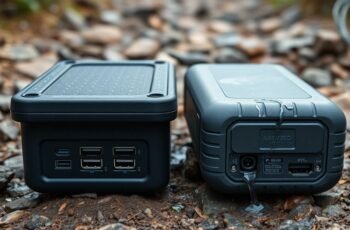
At the crossroads of portable power solutions, understanding the distinction between power stations and power banks is essential—each embodies a different approach to energy storage and delivery. These devices, like tools in a technician’s kit, serve specific purposes based on their design and capacity. As we examine their size, output, and suitability for various scenarios, a clearer picture emerges of which option aligns best with your needs—and the decision might not be as straightforward as it seems.
Key Takeaways
- Power stations have higher capacities (hundreds to thousands of Wh) and support larger devices; power banks are smaller, suitable for smartphones.
- Power stations are larger and heavier, designed for extended use; power banks are compact and portable for short-term needs.
- Power stations offer faster, multiple charging options like AC and DC; power banks primarily charge via USB for quick top-ups.
- Power stations are more expensive but provide longer lifespan and higher energy output; power banks are affordable but have limited capacity.
- Use power stations for outdoor events or emergencies; power banks are ideal for daily mobile device charging on the go.
What Are Portable Power Stations and Power Banks?
While both portable power stations and power banks serve as mobile energy sources, they differ markedly in design, capacity, and functionality. Portable power stations incorporate advanced battery technology, such as lithium-ion or lithium-polymer cells, optimized for high capacity and durability. They provide substantial energy reserves suitable for powering larger devices over extended periods. Conversely, power banks typically utilize similar battery chemistries but focus on compactness and rapid charging speed for smaller electronics like smartphones and tablets. Charging speed varies greatly; power banks often support fast-charging protocols to quickly replenish devices, whereas power stations prioritize sustained power delivery with slower, more controlled charging. Overall, the primary distinction lies in their capacity and intended application, driven by differences in battery technology and charging performance.
How Do Their Sizes, Capacities, and Power Outputs Differ?
Portable power stations are substantially larger and heavier than power banks, reflecting their higher capacity and more robust construction. They typically feature batteries with capacities ranging from several hundred to multiple thousands of watt-hours, enabling extended power supply and superior battery life for high-demand devices. Power outputs are also notably higher, often exceeding 1000W, which supports charging multiple devices simultaneously and running larger electronics. In contrast, power banks usually offer lower capacities—around 10,000mAh to 50,000mAh—and limited power outputs suitable for smartphones and small gadgets. Charging speed varies accordingly; power stations often have fast AC and DC charging options, while power banks focus on rapid USB charging. These distinctions underline their respective roles in different power needs, balancing size, capacity, and output capabilities.
Which Is Better for Camping, Outdoor Events, or Emergency Backup?
When choosing between a portable power station and a power bank for outdoor activities, the decision hinges on specific power requirements and environmental conditions. For camping, outdoor events, or emergency backup, a power station offers higher capacity, longer battery lifespan, and faster charging speeds for larger devices, making it suitable for extended use. Power banks, with their compact size and rapid charging capabilities, excel for quick power top-ups of smartphones and small electronics but lack endurance for prolonged power demands. The table below highlights key differences:
| Feature | Portable Power Station | Power Bank |
|---|---|---|
| Battery Lifespan | Longer | Shorter |
| Charging Speed | Slower for small devices | Faster for smartphones |
| Capacity | High | Low |
| Portability | Less portable | Highly portable |
Factors to Consider When Choosing Between a Power Station and a Power Bank
Selecting the appropriate power solution requires analyzing specific factors that influence performance, portability, and suitability for your intended use. Battery technology plays a critical role, affecting capacity, longevity, and safety. Power stations typically utilize advanced lithium-ion or lithium-polymer batteries, offering higher capacities and longer cycle lives compared to most power banks. Charging speed is another essential consideration; power stations often feature faster recharge times due to higher input wattage, enabling quicker turnaround during extended use or emergencies. Conversely, power banks offer rapid charging for small devices but generally have lower overall capacity. Assessing these factors helps determine whether a power station’s superior battery technology and faster charging speeds align with your needs or if a portable power bank suffices for lighter, short-term applications.
Cost, Portability, and Long-Term Use: Which Option Offers Better Value?
While initial acquisition costs are a primary consideration, evaluating the long-term value of power solutions requires analyzing their durability, maintenance expenses, and overall efficiency. Power banks generally feature advanced lithium-polymer or lithium-ion battery technology, offering high portability and low upfront costs but limited lifespan and capacity. In contrast, portable power stations utilize larger, more robust battery technology, which often translates to higher initial costs but better long-term durability and energy efficiency. From an environmental impact perspective, power stations with improved battery technology tend to have a lower environmental footprint over their lifespan, owing to fewer replacements and more sustainable materials. Ultimately, power stations provide better value for sustained, high-demand use, while power banks excel for short-term, lightweight applications.
Frequently Asked Questions
Can Power Banks Charge Devices Simultaneously?
Yes, power banks can charge devices simultaneously, depending on their charging capacity and device compatibility. We analyze these factors to guarantee efficient power distribution, optimizing performance without overloading circuits, consequently maintaining device safety and charging speed.
Are Portable Power Stations Suitable for Large Appliances?
Portable power stations are suitable for large appliances if their capacity exceeds the appliance’s power requirements. We analyze power station capacity against appliance wattage, ensuring compatibility, and recommending models with sufficient output to handle high power demands effectively.
How Long Do Power Stations and Power Banks Typically Last?
Power stations typically last 3-5 years, enduring around 500-1000 charging cycles, while power banks usually last 1-3 years with 300-500 cycles. Both depend on battery quality and proper maintenance for best lifespan.
Do Power Stations Require Special Maintenance or Refueling?
Power stations generally need minimal maintenance beyond regular battery longevity checks; they don’t require refueling but should be kept in a cool, dry environment to maximize lifespan. Routine inspections ensure ideal performance and safety.
Are There Eco-Friendly or Solar-Powered Options Available?
We find that eco-friendly and solar-powered options, like portable power stations with integrated solar panels, utilize renewable energy and eco-friendly materials, offering sustainable power solutions suitable for environmentally conscious users and reducing reliance on non-renewable sources.
Conclusion
In analyzing the differences, we see that choosing between a power station and a power bank hinges on specific needs, capacity, and portability. While the theory suggests larger devices always offer better value, our analysis shows that for short-term, low-power tasks, power banks are more practical and cost-effective. Conversely, for extended use and high-demand electronics, power stations provide the necessary capacity. Ultimately, understanding these nuances helps us select the most efficient power solution for our unique situations.