We assess portable power station health by verifying ownership and safety limits, then recording load, current, voltage, and time to cutoff to compute capacity in amp-hours and estimated runtime. We map performance across multiple loads, watch for aging signs like rising internal resistance or voltage imbalances, and monitor hotspot temperatures. If deviations appear, we escalate to professional BMS and insulation tests. We’ll guide you through precise steps and concrete actions, leaving a clear path forward—but the next steps demand careful, systematic checks.
Key Takeaways
- Regularly check healthy indicators: stable voltage under load, minimal idle fluctuations, balanced cell voltages, and no unusual heat or hot spots.
- Measure capacity, runtime, and charge efficiency with controlled loads, logging current, voltage, time, and temperature for reproducible results.
- Monitor aging signs: increasing internal resistance, faster self-discharge, reduced full-charge capacity, and uneven module performance.
- Perform safe at-home diagnostics: verify ownership, use precise loads, compute amp-hours, and map performance across multiple representative loads.
- When issues appear, seek professional testing: assess BMS, cell aging, insulation, and obtain a traceable fault report to guide remediation.
What a Healthy Portable Power Station Battery Looks Like
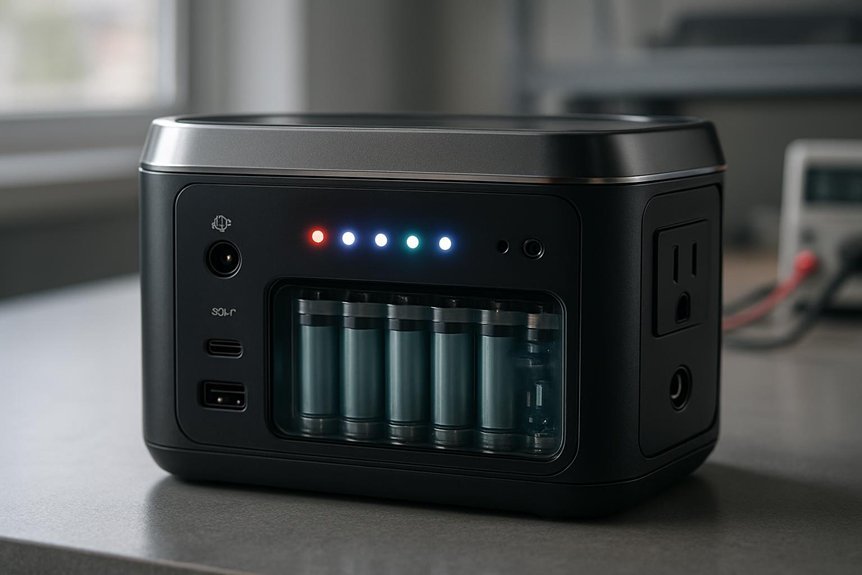
A healthy portable power station battery presents consistent performance, stable voltage, and no unintended self-discharge. We observe tight voltage tolerance under load, with minimal fluctuation between idle and peak draw, and stable internal impedance. Our assessment aligns with healthy benchmarks: gradual voltage sag during discharge mirrors expected chemistry, while rapid declines signal electrolyte degradation or cell imbalance. Temperature remains within target range, avoiding hot spots that indicate internal resistance growth. We verify state-of-health via balanced cell voltages and even charge distribution across modules. When aging indicators appear, like rising impedance or uneven cell voltages, we flag potential capacity loss and higher self-discharge risk. Overall, long-term reliability rests on predictable performance curves, controlled thermal behavior, and consistent charge acceptance, all confirming a battery in good condition.
Key Metrics: Capacity, Runtime, and Charge Efficiency
What are the core numbers we rely on? We measure capacity, runtime, and charge efficiency to quantify usable energy, duration between charges, and energy loss during charging. Capacity indicates total available watt-hours (Wh) and informs practical load limits, while runtime reflects how long the unit sustains useful output under a given load. Charge efficiency reveals losses during charging and discharging cycles. We track capacity fade over time to forecast end-of-life behavior and plan replacements. Cycle counting helps distinguish aging effects from intermittent faults, guiding maintenance decisions. Together, these metrics enable precise performance forecasting, comparisons across configurations, and informed usage strategies. We prioritize accurate logging, reproducible tests, and clear reporting to avoid misinterpretation and support data-driven interventions.
Signs of Battery Aging and Degradation
Over time, battery aging and degradation manifest as measurable changes in capacity, internal resistance, and self-discharge that alter real-world performance. We observe clear signals: gradual capacity loss, rising degradation indicators, and shorter runtimes. As we evaluate, we quantify how aging shifts the state of health, reducing usable energy per cycle and increasing heat generation under load. Runtime reduction parallels capacity decline, often accelerating with deeper discharges or high-temperature exposure. Below, we present a compact matrix to highlight the key distinctions and their implications.
| Indicator | Symptom | Impact |
|---|---|---|
| Capacity loss | Lower full-charge energy | Decreased run-time per charge |
| Degradation indicators | Rising internal resistance | Efficiency drop |
| Self-discharge | Faster self-discharge rate | More frequent recharging |
Safe At-Home Diagnostic Steps: How to Test Capacity and Run-Time
Can we reliably gauge your portable power station’s capacity and run-time at home with simple, repeatable tests? Yes, with controlled discharge and measurement protocols. We begin by verifying ownership verification and ensuring you’re operating within the device’s documented limits. Use a precise load, record current, voltage, and time until cutoff, then compute capacity in amp-hours and estimated runtime at a given load. Repeat tests at multiple representative loads to map performance trends. Control environmental factors: temperature, battery age, and calibration of the internal coulomb counter. Document any deviations from nominal spec; unusual results may indicate degradation or sensor drift. Be mindful of lack of warranty implications when performing self-tests, and avoid destructive cycles. If results suggest abnormal capacity loss, seek systematic comparison against baseline data rather than assuming fault.
When to Seek Professional Testing or Service
When should we call in a professional for testing or service? We should seek expert evaluation when performance deviates from spec, or after unsafe indicators appear. If symptoms persist after basic verifications, professional testing minimizes risk and confirms underlying faults. Look for severe capacity loss, inconsistent voltage outputs, or rapid, unexplained temperature rise. A qualified technician will assess cell aging, BMS integrity, and pack insulation with calibrated equipment, delivering a traceable fault report and recommended remediation. Early intervention can prevent complete pack failure or hazardous conditions. We include a concise decision table below to help you decide when upgrade, repair, or replacement is warranted.
| Symptom Indicator | Recommended Action |
|---|---|
| Severe capacity loss | Schedule testing; evaluate pack health |
| Inconsistent voltage outputs | Immediate diagnostic service; check BMS |
Symptom-to-Action: A Practical Troubleshooting Workflow
Curious how to move from symptom to solution in a battery pack? We present a structured diagnostic workflow that translates observed issues into concrete actions. First, capture the symptom succinctly, noting voltage, current, temperature, and load conditions. Then establish a baseline, comparing against manufacturer specs and prior logs. Next, apply a prioritized troubleshooting checklist to isolate likely causes such as cell imbalance, insulation faults, or BMS faults. We iterate tests only when safe, using controlled loads and precise measurements. Document findings at each step, update the hypothesis, and rule out peripheral hardware before replacing core components. This method reduces guesswork and accelerates repair. Our approach emphasizes repeatable checks, verifiable results, and clear escalation criteria for professional service when needed.
Frequently Asked Questions
How Often Should I Calibrate Battery Sensing on a Portable Power Station?
We should calibrate battery sensing calibration every 3–6 months, depending on usage. We monitor accuracy after calibration and adjust calibration frequency if readings drift, ensuring reliable calibration frequency. We recommend documenting results and maintaining consistent calibration procedures.
Can a Faulty Charger Affect Battery Health and Life?
Yes, a faulty charger can strain and degrade battery health; it causes battery stress through improper voltage and current. We’ll show how this risks long-term life, and outline safe charging practices to protect performance and longevity.
Do Temperature Swings Impact Runtime More Than Rated Capacity?
Yes, temperature swings markedly impact runtime more than rated capacity. We observe temperature effects causing runtime variability, accelerated battery aging, and efficiency loss, even when capacity remains constant. We quantify these effects to optimize performance and reliability.
Is There a Safe Minimum Runtime Threshold Before Replacement?
By arming, alarming, and acting, we say: yes—there is a safe minimum runtime threshold before replacement, typically dictated by device specs, warranty, and risk tolerance; monitor run-time drift, performance, and safety margins before replacing responsibly. replacement thresholds, runtime safety
What Is the Difference Between Capacity Loss and Power Point Failure?
Capacity loss refers to reduced overall energy storage; power point failure means the voltage/current at a specific output node collapses. We explain how capacity loss degrades runtime, while a failing power point interrupts delivery even if capacity remains intact.
Conclusion
We’ve walked through how a healthy portable power station should behave, and how aging subtly shifts that balance. If performance drifts, we’ll map capacity, runtime, and temps, noting any resistance creep or imbalances. Should we observe deviations, we’ll frame them as gentle caution signals rather than alarms, guiding careful, incremental checks. With precise data and clear thresholds, we’ll escalate only when needed, preserving safety, reliability, and instrumented insight for responsible remediation.